REVIEW · TOURS
Stockholm Metro Tour
Stockholm’s metro is not just a way to get around. It is an underground art route where a station can feel like a painted cavern, a garden, a museum, or a video game screen. This two-hour tour links several of the city’s most striking stops, using the trains as your path between them.
I like the small group limit of 10, which should make it easier to hear explanations and ask questions on busy platforms. I also like that metro tickets are included, so you can focus on the art rather than sorting out fares. The main drawback is the brisk pace: with several transfers and many stations, you will see a lot, but you will not linger everywhere.
Key points to know before booking
- Kungsträdgården begins the tour underground, with art linked to the park above and the blue metro lines.
- Rådhuset has a rough cave-like setting, often compared with a Viking grotto.
- Solna Centrum uses bold decoration that gives the station a strong visual identity.
- Thorildsplan is a treat for video game fans, thanks to its playful digital-style design.
- The route ends at T-Centralen, Stockholm’s busiest metro station, before you return to street level on Drottninggatan.
- English and Spanish tours are available, with a live guide, included tickets, and wheelchair access.
Why Stockholm’s metro makes a good art tour
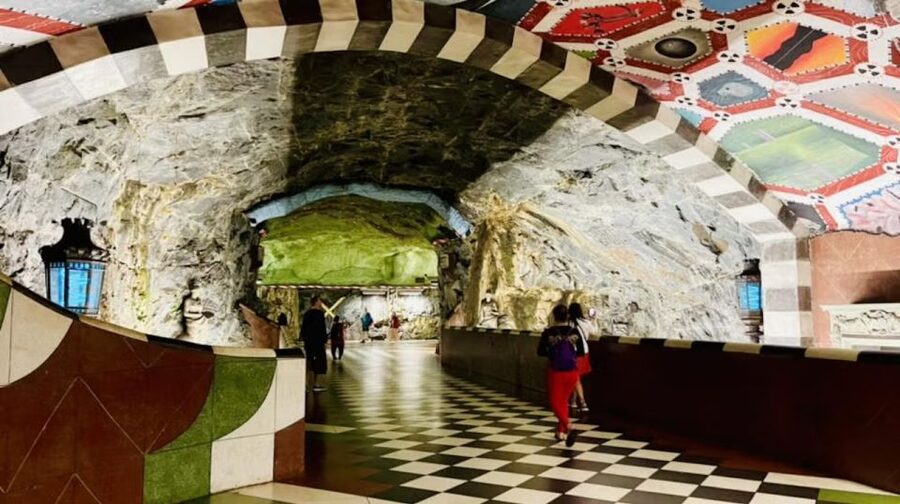
Stockholm’s metro is often called an art gallery beneath the city, but that description can sound grander than the experience really is. What makes it interesting is the variety. You are not walking through one underground exhibition. You are riding from station to station, and each stop changes the mood.
One platform may use rough rock and shadow. Another may suggest a public garden. Another may look as if it came from a brightly colored game world. The art is part of the daily transport system, not sealed away behind museum doors. Commuters use these spaces, trains rumble through them, and your guide helps you notice details you might otherwise pass without a glance.
The tour is especially useful if you are new to Stockholm. It introduces you to the blue, green, and red metro lines while also taking you beyond the central streets. You get a quick look at suburban Stockholm without giving up much of your sightseeing day.
You should think of this as an art and orientation walk, not a full museum visit. The route keeps moving, and the stations are public places. The reward is range: in two hours, you can compare several artistic styles and see how Stockholm’s transit system connects different parts of the city.
More Train Tours in the world:
- Bangkok: Damnoen Saduak Market and Maeklong Railway Market
★ 4.5 · 26,723 reviews - Mt Fuji and Hakone 1-Day Bus Tour Return by Bullet Train
★ 5.0 · 26,383 reviews - The Old Siam: Damnoen Saduak and Maeklong Railway Market
★ 4.5 · 10,992 reviews
Starting beside the Karl XII statue
The meeting point is near the Karl XII statue, close to Kungsträdgården metro station. This is a sensible place to begin because you are in the heart of Stockholm, with the park and central city nearby.
From there, you walk toward Kungsträdgården Station. Allow yourself enough time to locate the statue and guide before the scheduled start. The meeting point is outdoors, while the tour itself quickly moves underground, so dress for the weather during the opening walk.
The first part of the route takes about 25 minutes and introduces the metro system before the guided visits continue. Your guide provides the metro tickets, and the group travels together on the blue line. With a group capped at 10 people, the practical side should be manageable, though you still need to stay close during transfers.
Kungsträdgården, the Garden Station
Kungsträdgården is a fitting first stop. Its name refers to the royal garden above, and the station carries that idea below ground. The design is often described as garden-like, but it also has the unusual feel of an archaeological or theatrical set.
This is where the tour establishes its main theme: Stockholm’s metro does not treat the station as a blank corridor. Color, form, and decoration shape the whole space. Your guide explains how the station relates to the park and points out details that are easy to miss when you are simply waiting for a train.
I like starting here because it gives the tour a clear contrast with the stations that follow. You begin in central Stockholm, near one of its best-known public spaces, then move outward through the metro network. The art is not separate from the city. It grows out of the place above it.
The station can also be a busy starting point. If you prefer quiet, take your photos early in the explanation rather than waiting for an empty platform. The tour includes photography tips, but the guide still needs room to speak and the public still needs to use the station.
Rådhuset and the Viking grotto effect
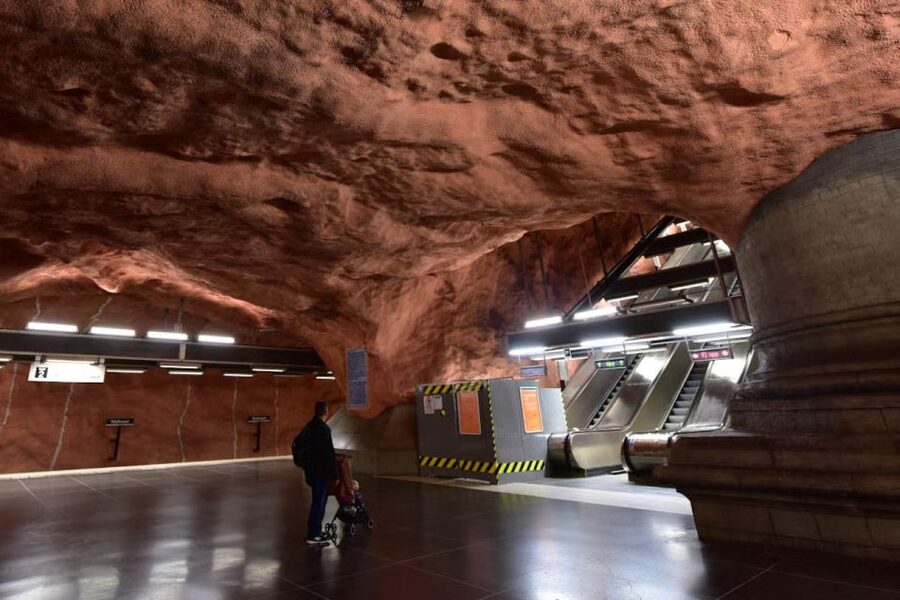
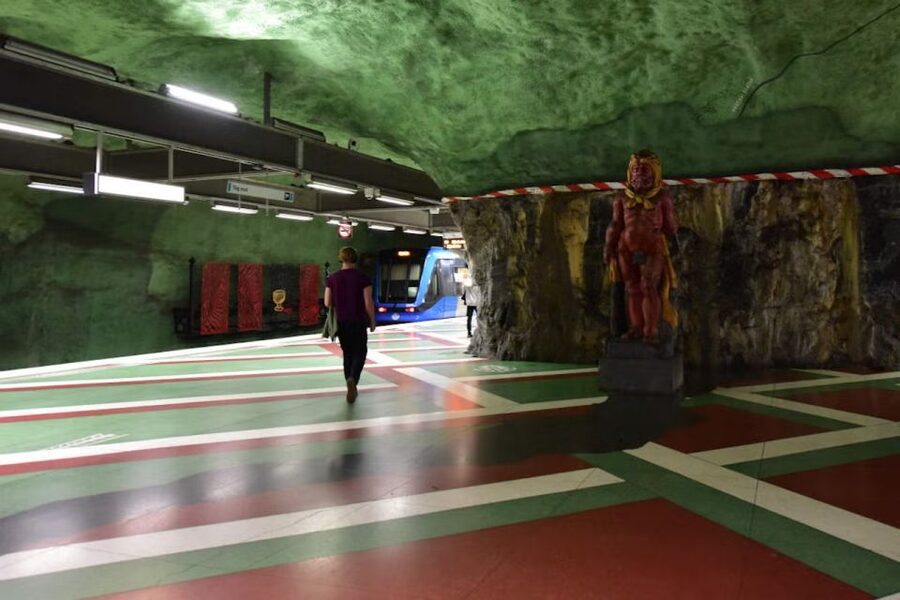
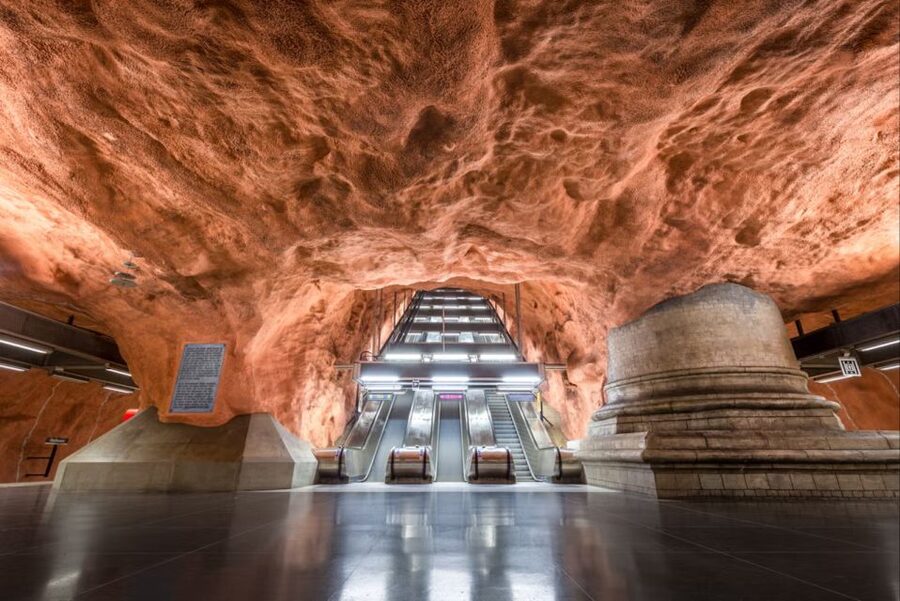
The next blue-line stop is Rådhuset, the station most likely to make you feel as if you have entered a cave. Its rough surfaces and earthy setting give the platform a raw, underground character. The comparison with a Viking grotto is useful because the station feels more like a carved rock space than a polished transport hall.
This stop shows why a guide adds value. You can see the exposed-looking surfaces on your own, but an explanation gives the design a clearer setting. The guide also shares stories about the creation of Stockholm’s metro and the city around it, helping you connect the visual style with the wider development of the network.
Plan to spend about 20 minutes here. That is enough time for an introduction, a few photographs, and a close look at the station’s atmosphere. It is not enough for a slow architectural study from every angle, so keep your expectations realistic.
The cave effect also means that photographs may need care. Dark rock, artificial light, and moving passengers can make quick snapshots difficult. The included photography advice is useful here, especially if you want more than a blurred phone picture.
Same tracks, a very different ride:
- Bangkok: Train Market & Floating Market with Boat Ride
★ 4.7 · 9,547 reviews - Mt Fuji & Hakone Cruise, Drum Show Bullet Train 1 Day from Tokyo
★ 4.0 · 7,413 reviews - Montserrat & Cogwheel Train, Gourmet Wine Tasting & Tapas/Lunch
★ 5.0 · 6,290 reviews - Hanoi: Guided Food Tour with Train Street Visit
★ 4.9 · 6,239 reviews
Solna Centrum and a stronger burst of color
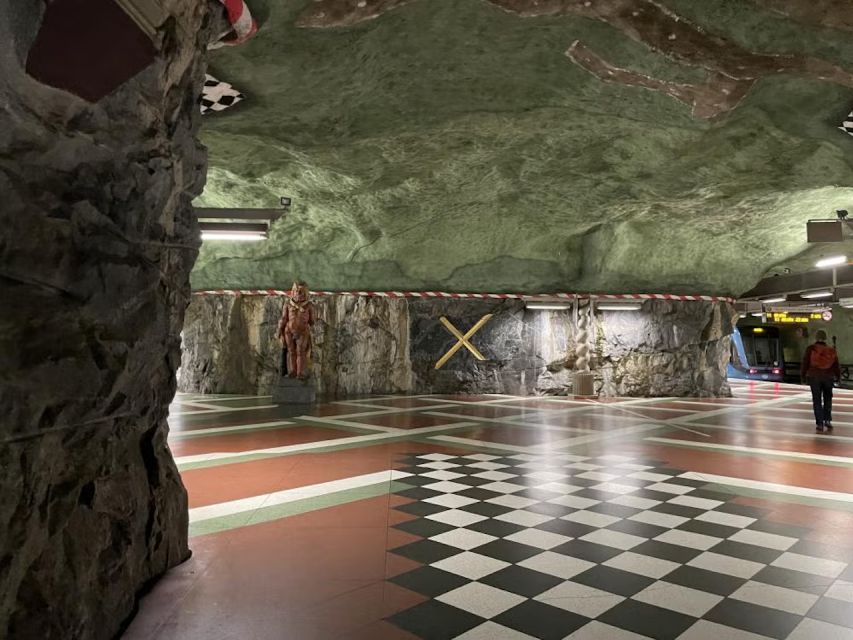
The blue line continues to Solna Centrum, where the decoration changes sharply. This station is known for a bold visual treatment that surprises many people after the darker mood of Rådhuset.
The appeal here is comparison. You are not simply visiting another decorated platform. You are seeing how different artists and design ideas can transform similar underground infrastructure. Rådhuset feels rugged and enclosed, while Solna Centrum makes a much stronger visual statement through color and decoration.
Your guide spends about 20 minutes explaining the station and its details. Pay close attention to the overall effect before reaching for your camera. The station works as a complete space, not just as a collection of small objects.
Solna Centrum also takes you outside the most central part of Stockholm. That matters if you want to see how the metro links the capital with its surrounding areas. You do not get a long neighborhood walk here, but you do get a glimpse of the city’s wider transport pattern.
Fridhemsplan, the changeover point
At Fridhemsplan, the group changes from the blue line to the green lines, numbered 17, 18, and 19. This transfer is part of the experience, but it is also where the route can feel most like a moving tour rather than a stationary art visit.
The guide keeps the group together while explaining the station and the change to the green line. A transfer can take a little attention, especially if the platform is crowded, so listen for clear instructions and stay near the group.
Fridhemsplan is included as one of the guided stops, with about 20 minutes allocated to it. Its role is both artistic and practical. It connects the blue-line section with Thorildsplan, and it gives you a better sense of how Stockholm’s lines intersect.
If you have trouble with stairs or long underground connections, the stated wheelchair accessibility is reassuring. Still, the route includes several station changes, so it is sensible to confirm any specific mobility needs when booking.
Thorildsplan for video game fans
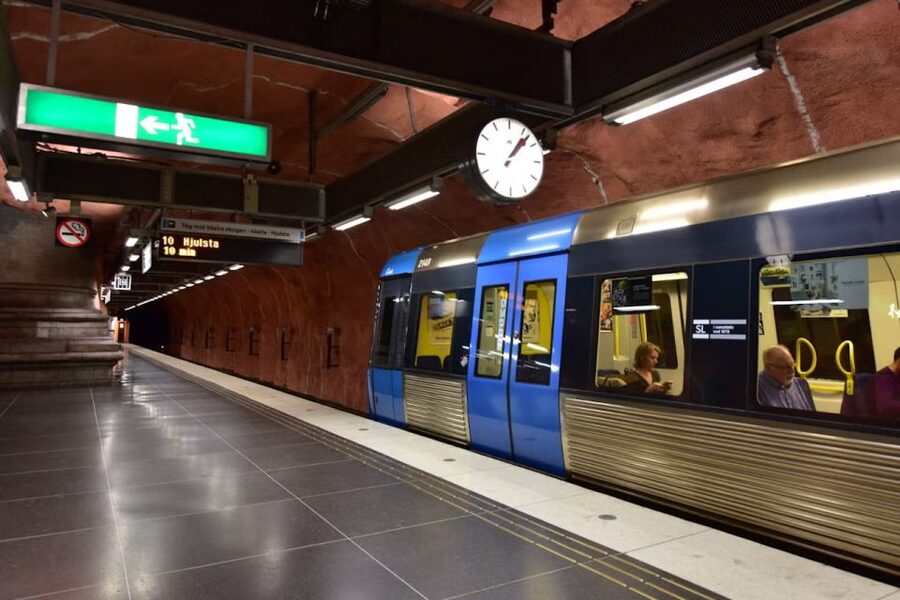
Thorildsplan is the most playful stop on the route. It is especially popular with video game fans because the wall designs use a pixel-like, digital visual language. The effect turns a normal metro passage into something that recalls an old-school game environment.
You do not need to be a gamer to enjoy this station. The design is easy to read at a glance, and it offers a welcome change after the natural rock forms and strong color schemes earlier in the tour. If you are traveling with children, this may be one of the easiest stops for them to appreciate.
The tour allows about 20 minutes here. That gives you time to see the designs, hear why the station has its unusual look, and take photographs. This is also one of the better places to use the photography tips from the guide because the repeated, graphic forms can work well in pictures.
The route then heads back toward central Stockholm. At this point, you have already crossed several parts of the metro network, so the return journey helps you understand the city’s layout. It is a practical lesson in using public transport as well as an art tour.
Stadium and the red-line change
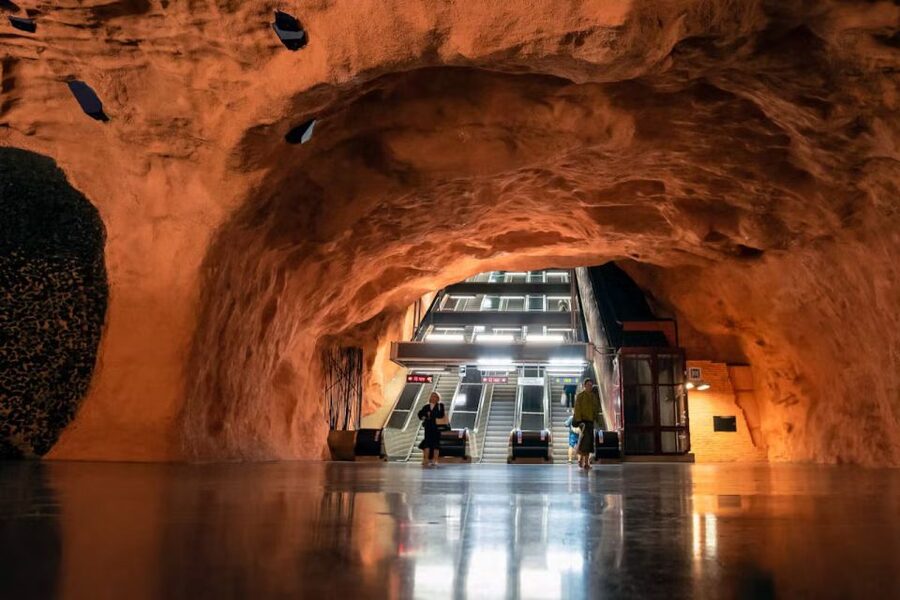
The group makes a quick transfer to the red line and visits Stadium, one of Stockholm’s best-known metro stations. Its design uses bold colors and a distinctive visual approach, giving the tour another clear change of mood.
Stadium is valuable because it shows how a station can rely on simple, forceful design rather than a cave effect or detailed scene-setting. You can appreciate it quickly, but the guide adds context and helps you notice how the design works across the station.
This stop also brings variety to the route. You have visited the blue line, green line, and red line, and each color-coded part of the network carries you to a different artistic setting. The tour is not simply a list of famous platforms. It is a short study in how public art changes the feel of a city’s shared spaces.
As with the other stations, the public nature of the metro is part of the experience. Trains arrive, people cross the platforms, and announcements continue. If you want a silent gallery, choose a museum. If you like art with everyday city life around it, Stadium fits the tour well.
T-Centralen and the return to street level
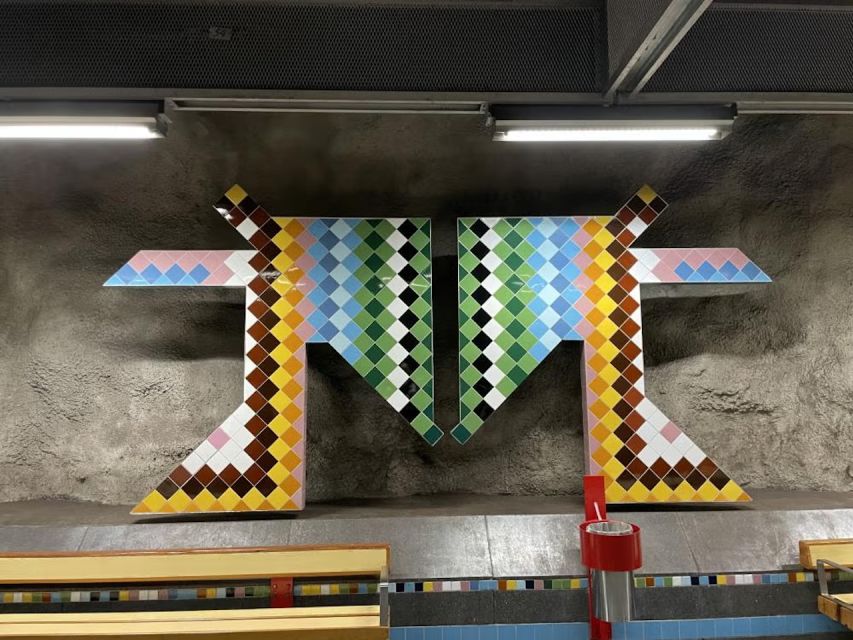
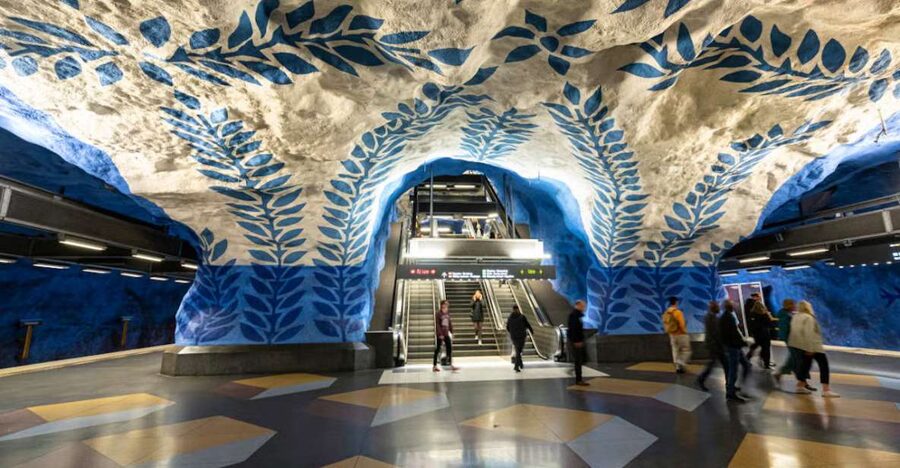
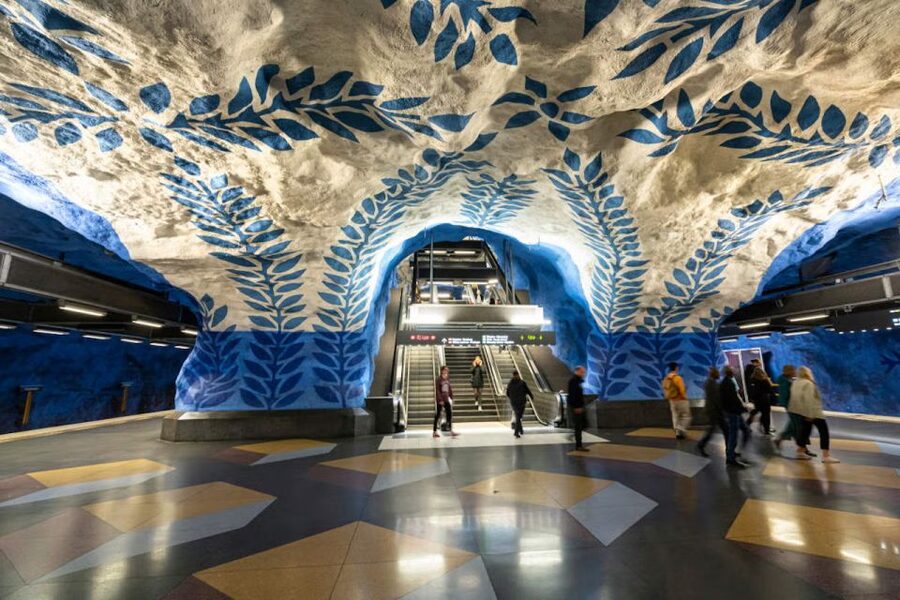
The final stop is T-Centralen, Stockholm’s busiest metro station. It is an appropriate finish because the station is a major meeting point in the network and has its own memorable decoration.
Here, your guide brings the different visual styles together. You have seen a garden-like station, a cave-like station, a highly colored station, a video game-inspired space, and Stadium’s bold design. T-Centralen gives you one last chance to see how art can make a busy transport hub feel more deliberate and distinctive.
The tour ends as you return to the surface along Drottninggatan, a lively pedestrian street in central Stockholm. This is a useful ending point for the rest of your day. You are back in the city center, rather than at an outlying station, with shops, restaurants, and other central sights nearby.
Because the tour ends at T-Centralen rather than returning to the starting point, pay attention to the meeting and finishing locations when planning your day. The route is designed as a one-way sightseeing loop through the metro, not a return trip to Kungsträdgården.
What the $80 price includes
At $80 per person, this is not the cheapest way to ride Stockholm’s metro. The value depends on how much explanation you want and how many stations you would realistically visit by yourself.
Your fee includes a local guide, metro tickets, cultural background, hidden details, photography tips, and a small-group format. If you already understand Stockholm’s metro and enjoy researching public art independently, you may find the price high. You could ride the lines yourself for less, though you would need to plan the route and interpret the stations without a guide.
The price makes more sense if you want a focused introduction in a short period. The route covers several lines and includes transfers that might be confusing on your own. You also get explanations about the city and the creation of its metro, not just directions from one platform to the next.
The small group matters here. With no more than 10 people, the guide can keep the pace personal and answer questions. Liliana, one of the guides associated with this experience, has been praised for her knowledge of the stations, Stockholm, and the metro’s development, along with offering practical ideas for restaurants and further outings. Guides may vary, but English and Spanish are offered.
Who will enjoy this two-hour route
I would choose this tour for art lovers who want something outside Stockholm’s usual museums and old-town streets. It also suits curious first-time visitors who want a quick introduction to the metro system and a look at suburban areas without giving up half a day.
Families may like the variety, especially at Thorildsplan. A seven-year-old was specifically welcomed by the guide on one booking, which suggests the experience can work well for children who enjoy color, unusual spaces, and trains. Still, the pace and platform changes may be tiring for very young children.
The tour is a good fit for photographers, but you need to work around public transport traffic. Bring a phone or camera that performs well in mixed light, and listen to the guide’s tips. You will have chances to take pictures, but this is not a private photo session.
It is less suitable if you dislike underground spaces, transfers, or a fixed pace. The tour includes several stations in two hours, so you should expect movement. You may also prefer a regular walking tour if your main goal is Stockholm’s streets, buildings, or food.
Pets are not allowed. The tour is listed as wheelchair accessible, and the live guide speaks English or Spanish. Free cancellation is available up to 24 hours before the start, and you can reserve now and pay later, which helps if your Stockholm plans are still changing.
Should you book the Stockholm Metro Tour?
Book it if you want to see several distinct metro stations with a guide who can explain the art, the city, and the transport system in one compact outing. The strongest parts are the variety of stops, the small group, the included metro tickets, and the chance to see Stockholm from below rather than following another standard city route.
Skip it if you would rather explore at your own speed or if $80 feels too high for a two-hour activity. Independent visitors can ride the same lines, but they will need to plan the sequence and do their own research.
For most visitors, I would place this early in a Stockholm stay. It gives you a useful feel for the metro, introduces several areas beyond the center, and leaves you at T-Centralen with the rest of the day still open. The 4.8 rating from 21 bookings reflects a strong experience, but the real question is simple: do you want a guided art outing with frequent movement, or a slower museum visit? Choose this tour for the former.
FAQ
How long does the Stockholm Metro Tour last?
The tour lasts two hours.
Where does the tour meet?
You meet at the Karl XII statue near Kungsträdgården metro station in central Stockholm.
Where does the tour finish?
The tour ends at T-Centralen, followed by a return to the surface along Drottninggatan pedestrian street.
Which metro stations are visited?
The route includes Kungsträdgården, Rådhuset, Solna Centrum, Fridhemsplan, Thorildsplan, Stadium, and T-Centralen.
What languages are available?
The live tour guide is available in English and Spanish.
Are metro tickets included?
Yes. Metro tickets are included in the tour price.
Just added around the world
- Zurich: Audio Guided City Tour and Train to “Top of Zurich”★ 4.2 · 65 reviews
- Zermatt Village & Gornergrat Railway Tour | From Bern★ 5.0 · 2 reviews
- Zagreb: Plitvice With Secured Tickets, Boat And Train Ride★ 4.6 · 15 reviews
- Zagreb: Private Walking Tour with Funicular Ride & Transfers★ 5.0 · 2 reviews
- York Day Rail Tour from London including Hop-on Hop-off tour★ 5.0 · 3 reviews
- Xi’an: Maiji Grottoes & Fuxi Temple Day Trip by Bullet Train★ 5.0 · 2 reviews
- Zagreb: Group walking tour of Zagreb (funicular included)★ 4.9 · 16 reviews
- Winter Tour Viking Village, Nærøyfjord Cruise & Flåm Railway★ 4.6 · 26 reviews
Tours, compared.
Dachau Concentration Camp Memorial Site Tour from Munich by Train
Read our review →
Tokyo Mt Fuji 5th St & Hakone Cruise Bus Tour w/Bullet Train
Read our review →
Half-Day Railway Market and Floating Market Tour in Thailand
Read our review →

Taj Mahal Tour from Delhi by Express Train (Viator Award Winner)
Read our review →
Street Food Tour with Train Street & Hidden Alleyways
Read our review →