
REVIEW · 6-DAY EXPERIENCES
Uzbekistan 6 Days Private Tour Khiva-Bukhara-Samarkand by Train
Khiva’s blue-tiled minarets, Bukhara’s old trading domes, and Samarkand’s grand Registan all fit into six carefully packed days. This private Uzbekistan tour links the country’s three great Silk Road cities by train, with airport pickup, hotels, guides, museum tickets, and city transfers arranged in advance.
I like the central hotels, which save time in cities where the best sights are close together. I also like the train plan: it gives you a useful break from road travel and connects the main stops without making you arrange every ticket yourself.
The trade-off is pace. You will see a lot, but Day 1 in Khiva and Day 5 in Samarkand are long sightseeing days. The Bukhara to Samarkand train is also subject to availability, so confirm the final schedule before you book.
Key details at a glance
- Three major Silk Road cities in six days: Khiva, Bukhara, and Samarkand form a logical west-to-east route.
- A private trip for your group: You do not share the activity with other tour parties.
- Train travel between cities: Khiva to Bukhara and Bukhara to Samarkand are covered, subject to the stated schedule and availability.
- Five nights in central hotels: Accommodation is in highly rated three-star or boutique properties.
- Museum entry is included: You do not need to budget separately for the listed sightseeing tickets.
- Flexible planning: The operator says the route can be customized at no or small extra charge, with desert or mountain detours available.
Why this route works so well
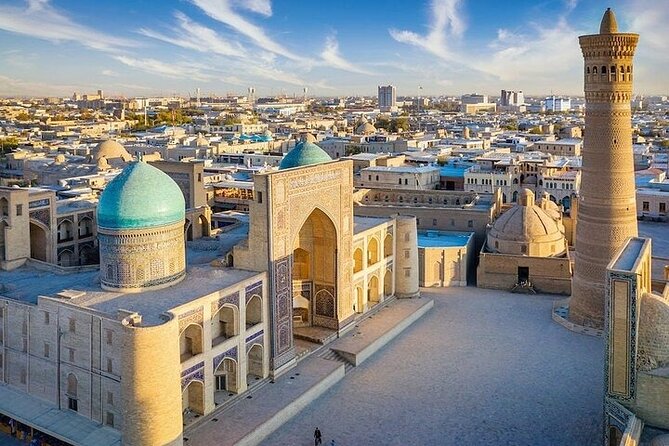
Uzbekistan’s classic sightseeing route is not hard to understand. Khiva gives you a compact walled old town. Bukhara spreads its sights around quiet squares, old mosques, and market domes. Samarkand finishes with enormous Timurid monuments and some of Central Asia’s most memorable tilework.
This six-day plan follows that order from west to east. You arrive at Urgench, move quickly to Khiva, take the train to Bukhara, continue by rail to Samarkand, and fly home from there. That means you avoid unnecessary backtracking.
The tour costs $800 per person. That is a useful price to assess as a package rather than as a simple guided sightseeing fee. It includes five nights of lodging, breakfast each morning, airport transfers, air-conditioned transport, local guides in each city, train tickets, entrance fees, and customer service around the clock.
You should still allow extra money for meals beyond breakfast, tips, and the small photo or video charges at museums. Those charges are listed at roughly $1 to $2 per museum. A single-room supplement costs $25 per night, or $125 for five nights.
A few more train trips around the world worth a look
- 6-day All Ireland & Northern Ireland Rail Tour from Dublin
★ 4.0 · 37 reviews - 6-Day Italian Lakes, Milan with Bernina Express Train Experience
★ 4.5 · 17 reviews - From Dublin: 6-Day All of Ireland Rail Tour
★ 4.4 · 15 reviews
Day 1: Urgench arrival and Khiva’s walled old town
Your first transfer begins at Urgench Airport. A driver meets you in the arrivals hall with a name sign, then takes you to Itchan Kala in Khiva. The airport pickup is a small but important detail after an international flight, especially when you are arriving in a city you may not know well.
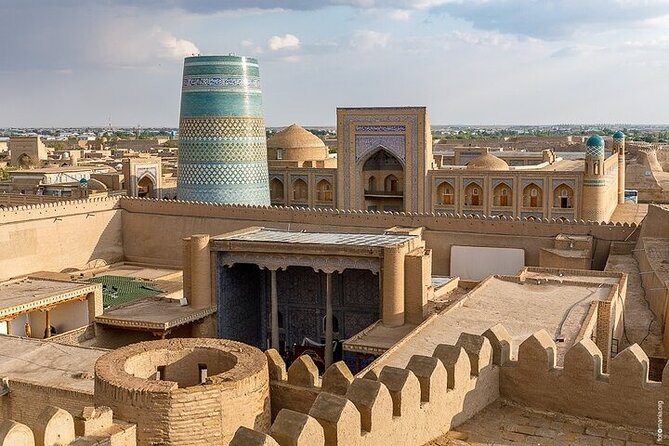
Itchan Kala is Khiva’s enclosed inner town, surrounded by brick walls that reach up to 10 meters. Its regular shape, narrow lanes, mosques, palaces, and madrassas make it easy to understand as a former seat of power. The outer town, Dishan Kala, was where ordinary residents, craftspeople, farmers, and smaller merchants lived.
Your first major sight is the Kalta Minor Minaret. Its unusual feature is not just its shape, but its unfinished state. Mohammed Amin Khan ordered a tower intended to rise more than 70 meters, yet construction stopped at about 29 meters. The result is a broad, brightly tiled minaret that looks more like a decorated tower than a finished spire.
Allow time at Kunya Ark, Khiva’s fortified citadel. It occupied the center of political life and contains several parts of the old ruling complex. Two hours here gives your guide room to explain how the khan’s court, military power, and religious authority operated from inside the walls.
The Pahlavan Mahmud Mausoleum brings a different mood. Pahlavan Mahmud was known locally as a poet, philosopher, strongman, and healer. The original tomb grew into a larger religious complex with a mosque and khanaka, and its large blue-tiled dome is one of Khiva’s defining sights.
The Juma Mosque is notable for its forest of wooden columns and its position near the center of Itchan Kala. It was the place where the khan’s name was read aloud during Friday prayers, a reminder that worship and government were closely tied.
You also visit Tash Khauli Palace, built between 1830 and 1838 for Allakuli Khan. Its courtyards and decorated rooms show the more formal side of Khorezm architecture. The Islam Khodja Complex adds a madrassa and minaret to the day’s list.
This is a lot for an arrival day. If your flight lands early, the schedule is workable. If you arrive tired, you may want to ask about adjusting the order or shortening one stop. The tour is private, so there is at least some room to discuss the pace.
Day 2: More Khiva, then the train east
The second morning gives you four hours to see more of Itchan Kala. That extra time matters. Khiva rewards slow walking because the main sights are close together, while smaller courtyards, carved doors, tile details, and quiet lanes can be missed during a quick circuit.
Use this free block to revisit a favorite monument, add an unlisted site if your guide recommends one, or simply walk without a strict checklist. The route already covers the major landmarks, so this is the best chance to keep the day from feeling like a parade of entrances and exits.
You then transfer to Khiva railway station for the train to Bukhara. The departure is listed as either 3:00 p.m. or 6:00 p.m., depending on the travel date, and the rail portion is planned at about six hours. That makes this a true travel day rather than a short transfer.
The train is valuable because it breaks up the long overland route and lets you watch the country pass by from your seat. It also means you do not need to arrange intercity tickets on your own. Still, check the exact departure time when you reserve. A later train will leave little time after arrival in Bukhara beyond the hotel transfer.
On arrival, a driver takes you from Bukhara station to your hotel. The tour uses Bukhara’s Kagan railway station for the Samarkand connection later in the trip, so do not confuse the station transfer with a city-center departure.
Day 3: Bukhara’s pools, domes, and royal fortress
Bukhara feels less like a single enclosed museum than Khiva. Its old center is spread across squares, lanes, religious buildings, and market areas. That makes the guide especially useful, since the importance of a modest-looking building can be easy to miss.
Begin at Lyab-i-Hauz, a square built around a water reservoir. The ensemble includes the Nodir Divan Begi Madrassa, a khanaka, and a former caravanserai. The pool gives the area a calm center and makes it a natural place to pause between monuments.
The Kalyan Minaret rises 45.6 meters beside the Kalyan Mosque and Mir-i-Arab Madrassa. The minaret dates to 1127 and survived the Mongol conquest. Its scale is impressive, but the wider Po-i-Kalyan square is what gives the sight its force. You can take in the minaret, mosque, and madrassa as one architectural group rather than three isolated stops.
The Ark of Bukhara is a royal town within the city. Rulers used the fortress for more than a thousand years, and its massive entrance gives you a sense of how power was physically separated from ordinary urban life. One hour is enough for the main visit, though the uneven historic setting may require comfortable shoes.
Across from the Ark, Bolo Hauz Mosque is associated with an octagonal pool. Its carved wooden columns and covered front porch make it one of Bukhara’s more elegant religious buildings. The visit is shorter, but it provides a useful contrast to the larger Kalyan complex.
Maghak-i Attari Mosque is presented as the oldest surviving mosque in Central Asia and is built over a site linked with earlier Buddhist and Zoroastrian worship. Its brickwork is the main attraction. Here, layers of religious and architectural change are close together in one small structure.
Finish at the trading domes, where old market buildings now contain artisan workshops and shops. This is a better place to browse than a modern shopping street if you want a reminder of Bukhara’s commercial past. Give yourself time to look before buying. The tour includes the visit, but purchases are your responsibility.
More Private Train Tours in the world:
- From Delhi: Private Taj Mahal and Agra Tour by Express Train
★ 4.9 · 1,605 reviews - Delhi to Agra and Taj Mahal Private Day Trip by Express Train with Lunch
★ 5.0 · 1,389 reviews - Private Excursion to Maeklong Railway and Floating Markets
★ 5.0 · 850 reviews - Floating and Railway Market (Optional Waterfall): Private Tour
★ 5.0 · 827 reviews
Day 4: Free time in Bukhara, then Samarkand

You get four hours at leisure in Bukhara before transferring to Kagan station. This is one of the most useful parts of the schedule because Bukhara has more than enough material for a second look.
You can return to Lyab-i-Hauz, spend time in the trading domes, visit additional monuments, or simply sit near the water and watch local life. The phrase treasure hunt is a good description of the morning, since the city rewards unplanned turns more than a rigid list.
The transfer to Kagan station takes about 20 minutes and covers roughly 15 kilometers. The Bukhara to Samarkand train is subject to availability, so this is the point where advance confirmation matters most. The tour includes the train ticket, but the exact departure time is not supplied in the schedule.
After arriving in Samarkand, a driver takes you to the hotel. The short transfer is welcome because the next day begins with a full set of major monuments.
Day 5: Timurid Samarkand from Gur Emir to Shah-i-Zinda
Samarkand’s sightseeing day is the most visually grand part of the tour. Begin at Gur Emir, the mausoleum associated with Timur. The building dates to the early 15th century and contains Timur’s tomb along with other members of the Timurid family.
The interior is the point here. Look for the blue decoration, the large dome, and the famous green jade tombstone associated with Timur. Your guide can help connect the monument to the political world that made Samarkand a capital of empire.
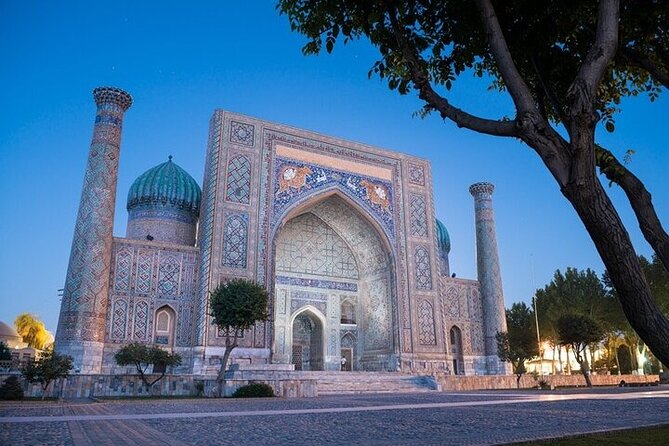
Then comes Registan, the city’s great square. Three madrassas surround it: Ulugh Beg, Sherdor, and Tillokori. Two hours gives you enough time to look at the façades and enter the buildings rather than merely stopping for a photograph.
Registan can feel almost too polished because much of what you see has been reconstructed. That does not make the visit worthless, but it is worth understanding the difference between a preserved ruin and a restored monument. The scale, color, and layout still explain why the square is the symbol of Samarkand.
Bibi Khanym Mosque was commissioned by Timur after his campaign in Delhi and built between 1399 and 1404. Its size reflects the ambition of the period. The mosque has suffered damage and restoration, so your guide’s explanation will help you read the surviving structure rather than judge it only as a finished building.
Nearby Siab Bazaar gives the day a more ordinary, local setting. The market is known for produce and handicrafts, and the 30-minute stop is a chance to see Samarkand as a living city rather than only a collection of monuments.
Shah-i-Zinda is one of the day’s most rewarding visits. The complex contains more than 20 mausoleums and 44 tombs on the southeastern side of Afrosiab. Its narrow passage of decorated façades is more intimate than Registan, with tile patterns changing from one tomb to the next.
The final stop is Ulugh Beg Observatory. Only parts of the original structure remain, including a section of the huge sextant used for astronomical work. Ulugh Beg was Timur’s grandson, but his importance here comes from science rather than conquest. The observatory gives the day a needed intellectual finish.
This schedule is full. Gur Emir, Registan, Bibi Khanym, Siab Bazaar, Shah-i-Zinda, and the observatory make for a long day of walking and standing. You should expect a lot of visual information and take water breaks when you can.
Day 6: Airport transfer and the end of the route
The final service is a transfer to Samarkand Airport for your flight home. The listed plan allows about 30 minutes for the drive, but you should confirm the pickup time with the operator against your flight details.
Airfare is not included among the listed inclusions, so book your own onward flight and check whether the route works with your arrival and departure times. Starting in Urgench and leaving from Samarkand is one of the strongest practical features of the trip because it keeps the route moving forward.
What the $800 price really covers
At $800 per person, the package offers a good amount of structure for a six-day private trip. You are paying for convenience as much as sightseeing: airport pickup, city transfers, train tickets, five nights of accommodation, breakfast, guides, and entrance tickets are bundled together.
The private format is valuable if you want to ask questions, slow down at a favorite monument, or request small changes. The operator also says it can add a desert or mountain detour, although you should ask how that affects the six-day schedule and cost.
The main extras are clear:
- Single room: $25 per night
- Museum photo and video fees: usually $1 to $2 per museum
- Tips for guides and drivers
- Meals beyond the five included breakfasts
- Your international or domestic flight arrangements
The hotels are described as central, highly rated three-star or boutique properties. That is a sensible level for this route. Central lodging matters more than luxury because it reduces transfer time and gives you easier access to Bukhara and Khiva’s old centers.
Who should book this private Uzbekistan tour?
I would choose this tour if you want Uzbekistan’s headline sights without managing every train ticket, hotel, transfer, and museum entrance yourself. It suits first-time visitors who prefer a private guide in each city and want the reassurance of a driver meeting them at airports and stations.
It also fits couples, families, and small groups who value flexibility. Group discounts may reduce the per-person cost, so ask for the exact rate if you are booking with several people.
I would hesitate if you want a slow trip with long afternoons at cafés or markets. The six-day schedule is efficient, but it is not leisurely. I would also ask for the exact train times before paying, especially for the Khiva to Bukhara journey and the Bukhara to Samarkand connection.
Final booking advice
Book this route if your priority is seeing Khiva, Bukhara, and Samarkand in one well-supported trip. The strongest features are the logical one-way route, private arrangements, central lodging, and included rail travel.
Before confirming, check your visa situation, flight times, hotel names, train departures, and whether a desert or mountain addition would make the schedule too tight. If you accept the brisk pace, this is a practical way to get a strong first look at Uzbekistan’s major historic cities.
FAQ
How long is the Uzbekistan private tour?
The tour lasts approximately six days and includes five nights of accommodation.
Where does the tour begin?
The tour begins at Urgench Airport in Uzbekistan, where a driver meets you in the arrivals hall with a name sign.
Which cities are included?
The route includes Khiva, Bukhara, and Samarkand, with transfers between them by train and vehicle.
Are train tickets included?
Yes. Train tickets for the Khiva to Bukhara and Bukhara to Samarkand journeys are included. The Bukhara to Samarkand train is subject to availability.
Are museum entrance fees included?
Yes. Entrance tickets to all listed museums are included, along with all fees and taxes. Photo and video charges of about $1 to $2 per museum are paid separately in cash.
Is the tour private?
Yes. Only your group participates in the activity. The operator also offers group discounts and says the itinerary can be customized at no or small extra charge.
Just added around the world
- Zurich: Audio Guided City Tour and Train to “Top of Zurich”★ 4.2 · 65 reviews
- Zermatt Village & Gornergrat Railway Tour | From Bern★ 5.0 · 2 reviews
- Zagreb: Plitvice With Secured Tickets, Boat And Train Ride★ 4.6 · 15 reviews
- Zagreb: Private Walking Tour with Funicular Ride & Transfers★ 5.0 · 2 reviews
- York Day Rail Tour from London including Hop-on Hop-off tour★ 5.0 · 3 reviews
- Xi’an: Maiji Grottoes & Fuxi Temple Day Trip by Bullet Train★ 5.0 · 2 reviews
- Zagreb: Group walking tour of Zagreb (funicular included)★ 4.9 · 16 reviews
- Wroclaw: Private Tour by smal Historic Tram (1,5h, 16 seats)★ 4.8 · 24 reviews
6-Day Experiences, compared.
6-day All Ireland & Northern Ireland Rail Tour from Dublin
Read our review →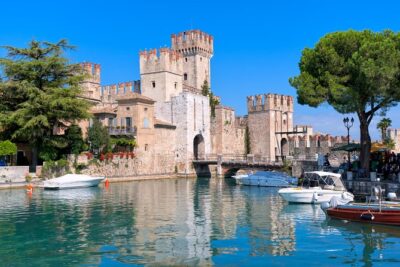
6-Day Italian Lakes, Milan with Bernina Express Train Experience
Read our review →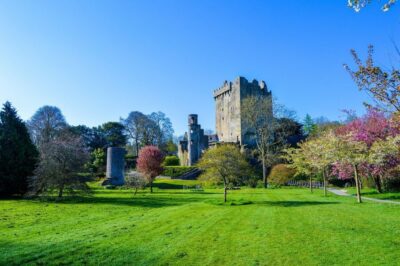
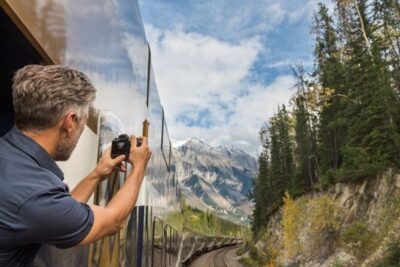
6-Day Rocky Mountaineer Train Tour, From Vancouver to Rockies
Read our review →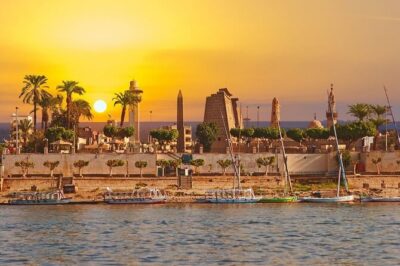
Kings of Ancient Egypt : 6 Days Cairo and Luxor Guided Tours & Overnight Train
Read our review →
6-Day Drive 9 Swiss Passes, Glacier Express Route +Stelvio, Italy
Read our review →
Marvel 6 Days Nile Cruise Aswan and Luxor & Sightseeing by Sleeper Train
Read our review →
6 Days Cruise Aswan to Luxor, Abu Simbel&Sleeper Train Round-trip
Read our review →Browse the lists this tour appears in