
REVIEW · ROME
Ancient Ostia Antica Semi-Private Day Trip from Rome by Train with Guide
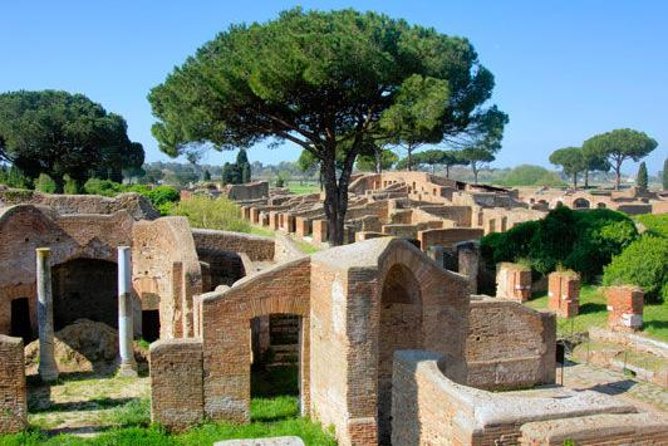
Ostia Antica gives you something Rome’s center rarely can: a chance to walk through an entire ancient city without the crush of the Colosseum. You follow the old Decumanus Maximus, pass taverns and apartments, and sit in an amphitheater built for 3,500 people. The scale is the surprise. This was once a working port town, not just a collection of grand monuments.
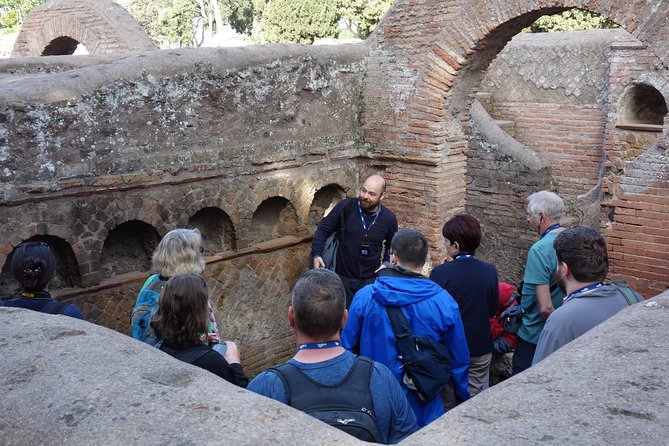
I like the easy train ride from Piramide and the small group, capped at 12 people. I also like that the guide leads you straight to the main sights, including the Baths of Neptune and the Forum of the Corporations, so your limited time is used well. The tradeoff is a brisk 2.5-hour walk over uneven ground, with stairs and little shade in places.
Key points to know before booking
- Ostia is an ancient Roman city, not a single monument: You see streets, homes, shops, temples, baths, and entertainment spaces in one large archaeological park.
- The train makes this a practical half-day from Rome: Meet near Piramide, ride with your guide, and return to the same area afterward.
- The group limit is 12 people: That usually gives you more room to ask questions than a large coach tour.
- The Baths of Neptune are a major highlight: Look for the mosaic of Neptune riding behind a four-horse chariot.
- Guide quality matters: Alberto, Barbara, Laura, Rob, Cat, and others have received especially strong praise for clear storytelling and good pacing, though guide assignments vary.
- Bring water and wear firm shoes: The site requires substantial walking, and hot days can be tiring.
Why Ostia Antica makes a smart Rome day trip
Pompeii gets most of the attention, but Ostia Antica is often the better choice if you are staying in Rome and have only half a day. You do not spend hours traveling across Italy. Instead, you meet near the Piramide metro station, board a regional train with your guide, and reach the archaeological park in roughly the time needed for a simple outing beyond the city center.
The setting also gives you a different picture of Roman life. Rome’s famous sights focus on emperors, temples, arenas, and political power. Ostia shows you where ordinary people lived and worked. You walk past apartment blocks, shops, public baths, taverns, and religious buildings. The city once served as Rome’s port, and its streets reveal the practical machinery of daily life.
That makes the visit especially useful if you have already seen the Colosseum and Roman Forum. You will recognize Roman building methods and civic design, but here you can picture a fuller neighborhood rather than a few isolated structures.
The archaeological park is large. A first-time visitor can easily spend hours wandering without a clear sense of what matters most. The guide solves that problem by setting a route through the principal sights and explaining how the pieces fit together.
More Day Tours in Rome:
- From Rome: Ostia Antica Guided Half-Day Trip by Train
★ 4.8 · 486 reviews - Venice Day Trip from Rome by High-Speed Train with Happy Hour
★ 4.5 · 445 reviews - From Rome: Day Trip to Venice by High-Speed Train
★ 4.6 · 352 reviews
Meeting near Piramide and taking the train
The tour begins at P.za Ostiense, 11, near Piramide. This is not a hotel pickup, so you need to make your own way to the meeting point. Plan to arrive early. One useful tip is to look for a message from the operator on the morning of the tour and aim to be at the meeting place about 20 minutes before departure.
Your guide provides the round-trip train ticket. That removes one small but annoying task from the morning, especially if you are unfamiliar with Rome’s transit system. You ride out together, which also gives the guide a chance to set expectations before reaching the ruins.
This is a functional part of the experience rather than a sightseeing segment. Still, I like the fact that the excursion uses public transportation instead of adding a private vehicle and a long road transfer. You see a little more of the area southwest of Rome, and the train keeps the trip affordable.
The tour lasts about four hours in total, with roughly 2.5 hours spent walking through Ostia Antica. The schedule is long enough to cover the main route but short enough to fit around other Rome plans. Allow a little flexibility, since train connections, site conditions, or the pace of the group can sometimes extend the outing.
Walking the Decumanus Maximus
Once inside, the guide takes you along the Decumanus Maximus, the main road through the ancient town. This is where Ostia begins to make sense. Rather than seeing one grand ruin at a time, you watch the city unfold around a real street.
The road leads past sidewalks, building fronts, statues, and the remains of commercial spaces. Your guide explains how the town functioned as a port for ancient Rome and how its population may have reached more than 100,000 at its height. That context helps you read the ruins as a city, not as scattered stones.
Look carefully at the smaller buildings. The shops and living quarters are among the most useful parts of the route because they bring the ancient town down to human scale. You can imagine people buying food, working in storefronts, moving through narrow entrances, and returning to apartments above or behind the commercial spaces.
The guide’s storytelling style can shape the experience. Guides such as Alberto have been praised for mixing humor, clear explanations, and good time management. Barbara has also earned praise for keeping the group involved while making ancient history easy to follow. Names and assignments are not guaranteed, but these examples show the kind of guide that makes the walk work best.
The Baths of Neptune and Ostia’s surviving mosaics
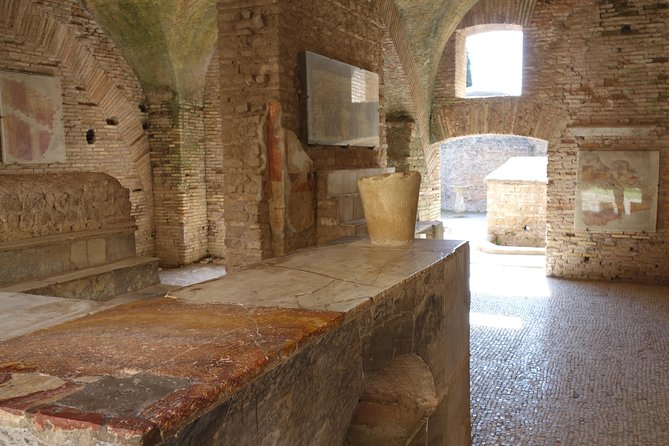
The Baths of Neptune are one of the tour’s visual highlights. The large mosaic shows Neptune, the Roman god of the sea, riding behind a four-horse chariot. Since Ostia was a port city, the subject feels especially fitting.
The mosaic is not just a decorative stop. It gives you a chance to see how Romans used public bathing complexes as social and civic spaces. The baths were places to wash, exercise, meet other people, and spend time away from home. Your guide can point out the art and architecture while explaining how these facilities fitted into everyday Roman life.
Ostia’s preserved statues and mosaics are another reason to choose this site. The remains are not limited to monumental fragments. Walkways still guide you through the old town, and decorative details appear in places where you might otherwise see only broken walls.
The park is open and exposed in many areas. On hot days, a good guide will pause in shade when possible and point out places to refill water bottles. Bring your own water anyway, wear a hat, and avoid treating this as a quick stroll. Even a relaxed pace adds up over several hours.
More Private Train Tours in Rome:
- Venice Day Trip from Rome: Private Tour by High Speed Train
★ 4.0 · 58 reviews - Venice by Train from Rome: Enjoy a Private Day Tour Experience
★ 4.5 · 28 reviews - Venice from Rome: Private Day Trip by train with Islands Tour
★ 5.0 · 25 reviews - Villa Adriana Private Day Trip from Rome By Train
★ 5.0 · 9 reviews
Sitting in the ancient amphitheater
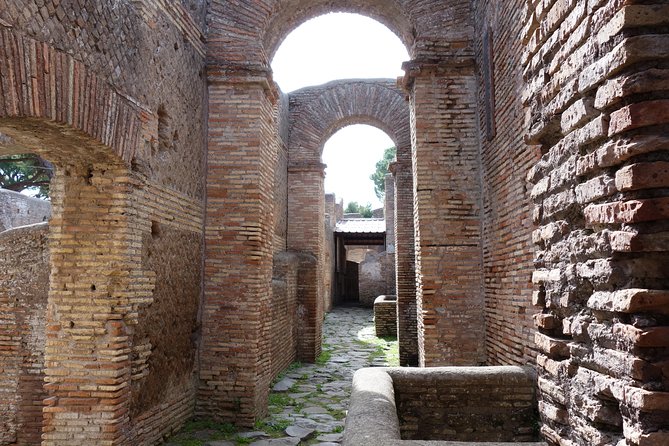
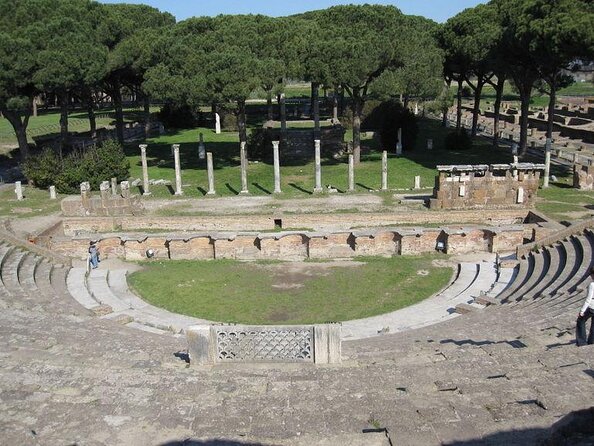
The amphitheater dates to 12 BC and once held about 3,500 spectators. You can take a seat and look across the structure, which makes this stop more immediate than simply viewing it from a path.
It is smaller than Rome’s Colosseum, but that is part of its appeal. The proportions allow you to understand how the audience would have been arranged and how the building fit into the town. The stop also offers a natural pause during the walk.
A strong guide uses the amphitheater to explain entertainment in a local setting rather than treating it as another isolated Roman ruin. Guides such as Laura have been praised for adjusting the pace and keeping the group together when the site becomes busy with school groups. That can matter here, since the path and seating areas may not feel private during busy periods.
The amphitheater is also a good place for photographs. You get a sense of the surrounding ruins without needing to climb to a dramatic viewpoint.
Forum buildings, temples, shops, and homes
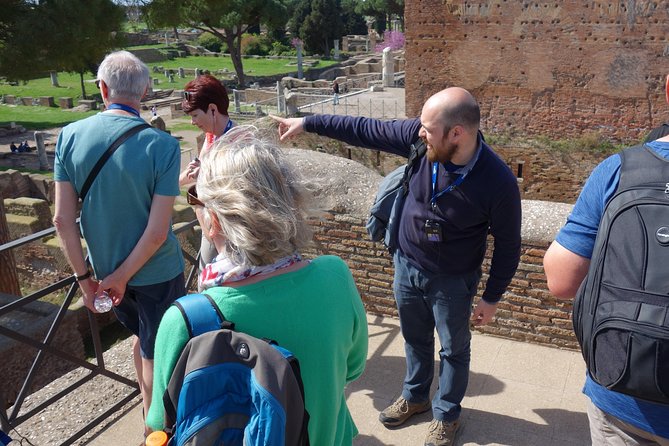
The route includes the Forum of the Corporations and the Collegiate Temple. These sites help explain the town’s commercial and religious life. Ostia served Rome’s port, so its public buildings were tied to trade, shipping, administration, and worship.
You will also pass remains of taverns, apartments, and public facilities. These less-famous structures may be more revealing than a temple because they show how people used the city every day. I find this the strongest reason to visit Ostia instead of collecting another set of imperial monuments in central Rome.
The ruins are remarkably legible in places, but the park is still extensive and partly fragmentary. Do not expect every wall to have a clear label or every room to look complete. The guide’s job is to supply the missing connections: what a building may have been used for, how the road system worked, and why the location mattered.
Some visitors want a slow archaeological study and may find the fixed route too limited. Others, especially families and first-time visitors, may appreciate the structure. The tour can also leave you with enough time to continue exploring after the formal walk, depending on the day’s timing and the guide’s instructions.
How the small group affects the experience
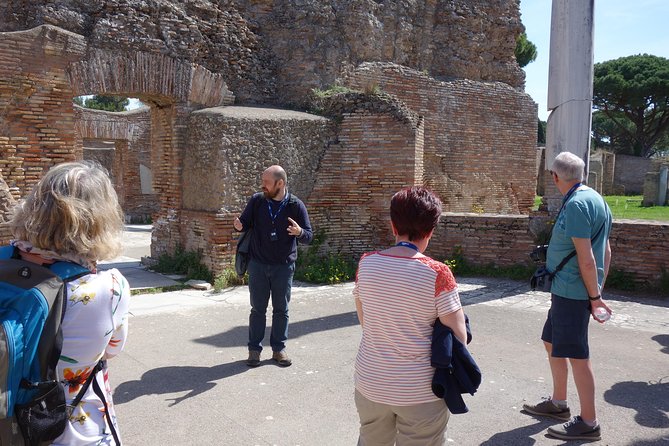
The maximum group size is 12. That is not a private tour, but it is small enough for a guide to answer questions without stopping for a crowd of 30 or 40 people.
The best guides use this format well. Alberto has been singled out for keeping a group moving while explaining buildings clearly and allowing time for questions. Rob has been praised for making sure people stayed comfortable during a very hot day. Cat and Laura have also received strong praise for friendly, well-organized tours.
There is a less pleasant possibility: not every guide will match your preferred style. A few people have found the explanations too flat or the pace too fast. One participant with a knee problem felt ignored when the group moved ahead. The operator responded that the issue would be addressed, but the practical lesson is simple: tell the guide at the start if you need extra time, and consider whether a long walking tour suits your mobility.
This is not the right outing for anyone who needs a fully step-free route or regular seating. The site includes uneven surfaces, stairs, and long stretches on foot. The physical requirement is moderate, but heat and rough ground can make it feel harder.
Is the $59.26 price good value?
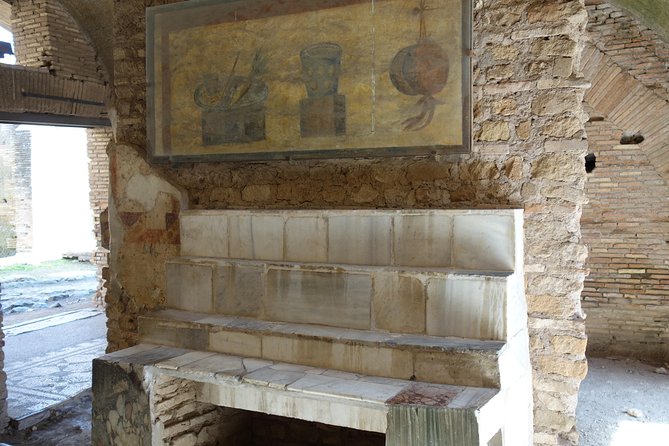
At $59.26 per person, the price covers the English-speaking guide, round-trip train ticket, and entrance to Ostia Antica. That makes the cost fairly easy to assess. You are not paying only for transport, and you do not need to add the site admission or figure out the train ticket separately.
The strongest value comes from the guide. Ostia is too large to understand fully from a casual walk, and the first visit can be confusing without a route. A good guide helps you see why the baths, commercial buildings, roads, and amphitheater belong to one functioning town.
The price is less attractive if you prefer complete freedom. You can reach Ostia by train on your own and use an audio guide at the park. That option lets you stay longer, skip sections, or move at your own pace. It also leaves you responsible for transport, admission, and making sense of a very large site.
For most first-time visitors, the included logistics and compact route justify the cost. If you already have a strong background in Roman archaeology, you may prefer an independent visit with more time.
Tips for a smoother Ostia Antica visit
Wear shoes with firm soles. Ancient roads and paths are uneven, and the tour involves stairs and a good deal of walking.
Bring water, sunscreen, and a hat. Hot weather can make the open sections uncomfortable, and shade is not guaranteed at every stop.
Keep your schedule flexible by a small margin. The planned duration is about four hours, but train delays or site conditions can add time.
If you are visiting with children or teenagers, explain that this is a city walk rather than a sequence of dramatic monuments. The amphitheater, mosaics, shops, and baths provide variety, and some families find the half-day length manageable.
Anyone under 18 might be asked to show an identification card at the entrance. Bring it if that applies to you.
The same train line can make it possible to continue toward the coast after the tour, but this excursion itself returns to the original meeting point in Rome. Treat any extra outing as a separate plan rather than something included.
Should you book this tour?
Book it if you want to understand how ordinary Roman life worked, prefer a half-day outing from Rome, and value a guide who can turn a large archaeological park into a clear story. It is especially useful if Pompeii is not practical for your schedule.
Skip it if you dislike group pacing, need a completely accessible route, or want several hours to explore every corner on your own. An audio guide and independent train trip may suit you better.
For most visitors, the combination of a short train ride, included admission, a group of no more than 12, and a strong route through the city makes this a worthwhile change from central Rome’s crowded monuments. Just arrive early, bring water, and remember that the quality of the day depends heavily on the guide assigned to your group.
FAQ
Where does the tour start?
The tour starts at P.za Ostiense, 11, 00154 Roma RM, near the Piramide metro station. Hotel pickup and drop-off are not included.
How long does the experience last?
The total experience takes about four hours. Approximately 2.5 hours are spent walking through the archaeological site.
What is included in the price?
The price includes an English-speaking guide, round-trip train tickets from Rome, admission to Ancient Ostia, and a semi-private group limited to 12 people.
What will I see at Ostia Antica?
The route includes the Decumanus Maximus, Baths of Neptune, amphitheater, Forum of the Corporations, Collegiate Temple, taverns, public baths, shops, apartments, and other ancient structures.
Is the tour suitable for people with limited mobility?
A moderate level of physical fitness is recommended. The visit includes uneven ground, stairs, train transfers, and substantial walking, so it may be challenging for anyone with limited mobility.
Can I cancel for a refund?
You can cancel at least 24 hours before the start time for a full refund. Changes or cancellations made less than 24 hours before the tour are not accepted for a refund. If poor weather or an insufficient number of bookings causes the operator to cancel, you will be offered another date or a full refund.
Just added around Rome
- Rome: Castelli Romani Day Trip by Train and E-Bike★ 5.0 · 4 reviews
- Venice from Rome: Full Day Small Group Tour by Fast Train★ 4.5 · 14 reviews
- Florence and Venice from Rome: 2-Day Semi-Private Tour by Train★ 5.0 · 2 reviews
- Villa Adriana Private Day Trip from Rome By Train★ 5.0 · 9 reviews
- Florence from Rome by High Speed Train at your pace★ 4.5 · 11 reviews
- Capri Island Small Group Boat Tour from Rome by Train★ 4.5 · 69 reviews
- Venice from Rome: Private Day Trip by train with Islands Tour★ 5.0 · 25 reviews
- Transfer from Civitavecchia by train with Rome HopOnHopOff Option★ 3.5 · 4 reviews
Rome Train Tours, compared.
Rome to Pompeii Guided Tour with Wine & Lunch by High Speed Train
Read our review →
Pompeii Tour with Wine and Lunch by High Speed Train
Read our review →
Venice Day Trip from Rome by High-Speed Train with Happy Hour
Read our review →

Tuscany Comfort Day Tour from Rome with Wine & Lunch
Read our review →
Rome to Florence: High-Speed Train Day Trip with Guided City Tour
Read our review →
Pompeii and Naples Day Trip by High-Speed Train
Read our review →Browse the lists this tour appears in