
REVIEW · HONG KONG
Hong Kong|Ding Ding Tram Ride with Cultural Landmarks Tour
Hong Kong’s old double-decker Ding Ding tram is more than a way to get around. On this route, it becomes a moving history lesson, carrying you from Wan Chai’s restored tong lau houses and temples to Causeway Bay’s unusual villain-hitting ritual and Quarry Bay’s famous Monster Building. You get street-level views without sitting in a tour bus.
I like the mix of big landmarks and everyday places. Blue House, Wan Chai Market, and Pak Tai Temple show different sides of old Hong Kong, while the tram gives you a local-style ride between them. I also like the small cultural details, especially the folk ritual under Gooseneck Bridge and the personal stories at Hong Kong House of Stories.
The main catch is pace. The tour lasts about three and a half hours, but it includes several walking stops and long periods on your feet. Communication with guide Sandra Choi was reported as good, though one departure had to move about 90 minutes because of problems with a larger 60-person morning tour, so keep your schedule flexible.
Key points to know before you book
- The Ding Ding is the tour’s main character: You ride Hong Kong Island’s century-old tram system on the upper deck, with views of streets, shops, towers, and old neighborhoods.
- Wan Chai provides the strongest cultural focus: The route links The Pawn, Blue House, Hong Kong House of Stories, Pak Tai Temple, and Wan Chai Market.
- Villain hitting is the most unusual stop: Under the Canal Road Flyover, elderly women perform a Cantonese folk ritual meant to drive away bad luck.
- The route finishes at Monster Building: Yick Cheong Building in Quarry Bay gives you one of Hong Kong’s most striking views of tightly packed public housing.
- You need stamina more than specialist knowledge: Most people can take part, but the tour includes walking and standing, and strollers or limited mobility can make it difficult.
- The price covers more than a tram fare: At $76.38 per person, you are paying for the guide, cultural stops, route planning, tram fare, and a pastry, not simply a ride across the island.
Why the Ding Ding tram makes this route different
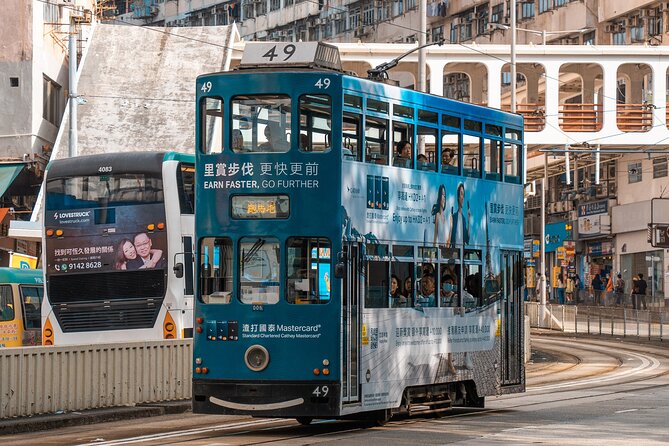
Hong Kong’s double-decker trams are known locally as Ding Dings, named for the warning bell used as they move through traffic. This tour uses the tram as a thread connecting several districts rather than treating it as a quick photo opportunity.
From the upper deck, you see Hong Kong at street height. That matters here. The route is about how old buildings, markets, temples, apartment blocks, and modern roads sit beside one another. A coach would give you a wider view, but it would separate you from the sidewalks and shopfronts that make this part of Hong Kong interesting.
The tram system is more than a century old and is one of the city’s enduring public transport links. You will not spend the whole three and a half hours riding. The tram connects walking sections, while the guide explains the places along the way in English or Chinese.
The tour begins at MTR Wan Chai Station at 2:00 pm and ends at MTR Quarry Bay Station. That start and finish make the route useful if you want to continue sightseeing in either district afterward. You receive a mobile ticket, and the experience is limited to a maximum of 25 people, a much more manageable size than a 60-person group.
More Tram and Streetcar Tours in China
- Hong Kong: Big Bus Hop-On Hop-Off Tour & Optional Peak Tram
★ 4.4 · 982 reviews - Hong Kong City Tour + Lunch + Peak Tram
★ 4.5 · 154 reviews - Top-Rated Hong Kong Tour: Peak Tram, Dim Sum & Cultural Sights
★ 4.5 · 99 reviews
The Pawn: old architecture with a modern use
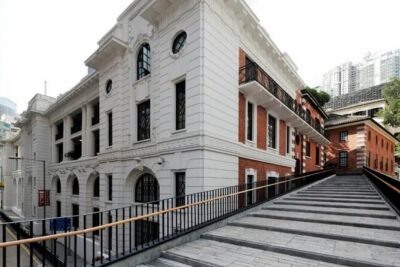
The first stop is The Pawn, a British restaurant and bar inside a restored 19th-century pawn shop in Wan Chai. Its value for this tour is architectural. You see how an old commercial building can be kept in use rather than left as a shell.
The setting also helps introduce Wan Chai’s changing identity. Heritage buildings now share the district with restaurants, bars, markets, homes, and busy roads. The stop is listed for about 30 minutes, with no separate admission charge.
You should think of this as a short cultural stop, not a meal reservation. The tour includes a pastry, but other food and personal expenses are not included. If you want a full meal or a drink at The Pawn, you would need to handle that separately, and the group’s schedule may not allow much extra time.
Hong Kong House of Stories and Blue House
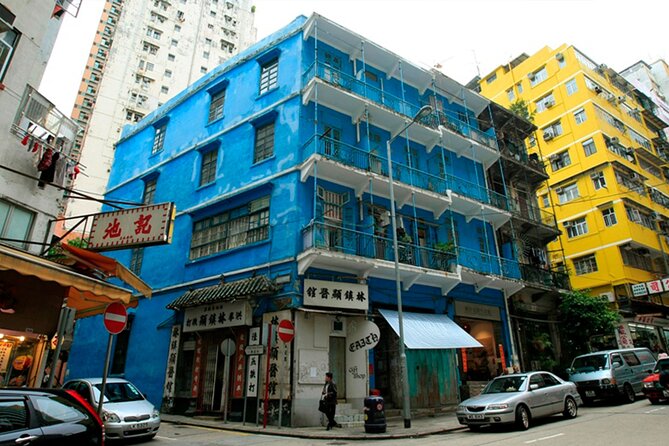
At Hong Kong House of Stories, you visit a small community museum located in the historic Blue House. The displays focus on personal stories, everyday objects, and local customs. That approach is useful because it moves the experience away from dates and grand monuments. You get a sense of how ordinary life shaped the neighborhood.
The museum is housed in Blue House, a four-storey tong lau built in the 1920s. Tong lau buildings traditionally combined shops or businesses at street level with homes above. Blue House is easy to recognize because of its bright blue exterior, but the color is only part of its appeal.
The building is part of a conservation project recognized by UNESCO, and it remains a living community site rather than a sealed-off historic monument. That gives you an important Hong Kong lesson: preservation here is not only about saving façades. It is also about keeping local stories and neighborhood functions visible.
The two stops are closely linked, so the guide can explain the building and then show you the material and personal sides of its past. Give yourself time to look at the small details. This is not the kind of museum where the scale impresses you. Its strength is the connection between a real building and the people associated with it.
Pak Tai Temple and Wan Chai Market
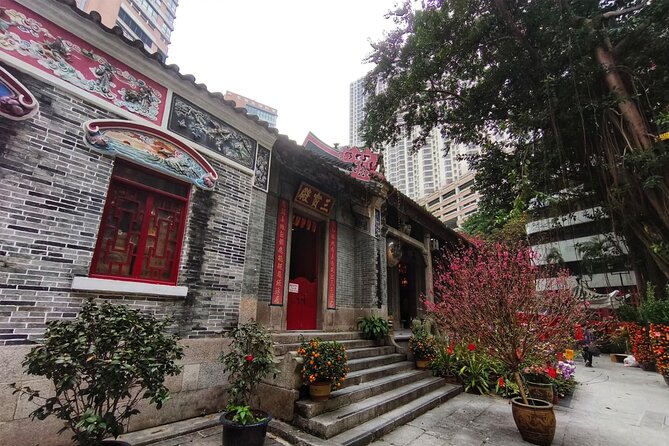
Pak Tai Temple adds a completely different mood. Built in 1863, it is a Taoist temple dedicated to Pak Tai, a god associated with war and water. The temple is known for its peaceful atmosphere and a tall bronze statue from the Ming dynasty.
This is a place where your behavior matters. Keep your voice low, follow the guide’s instructions, and be polite around worshippers. The temple is not simply a stop for photographs. Its value comes from seeing a working religious place within a dense urban district.
The 30-minute allocation gives you enough time for an introduction and a look around, but it is not an extended temple study. If you are especially interested in religious art or Taoist practice, you may want to ask the guide focused questions while you are there.
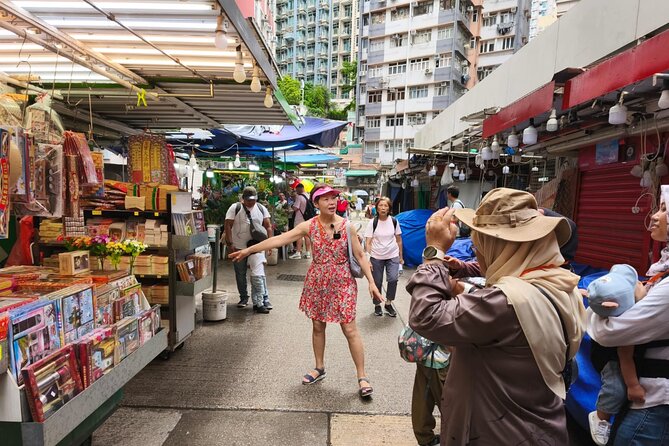
Wan Chai Market then brings you back into daily street life. The market, on Queen’s Road East, was originally built in 1937 and sells fresh produce, meat, seafood, and local snacks. The contrast with Pak Tai Temple is part of the route’s appeal. One stop asks you to slow down and observe religious customs. The next places you among the food and trade that keep a neighborhood functioning.
A traditional wet market can be crowded, wet underfoot, and full of strong smells. Wear proper shoes and keep your belongings close. This is not a polished shopping center, and that is exactly why it gives you a more grounded view of Wan Chai.
More Tram and Streetcar Tours in Hong Kong:
- Hong Kong: City Landmarks Tour + Peak Tram Ticket + Lunch
★ 4.1 · 371 reviews - Hong Kong Day Tour: Priority Peak Tram, City Walk & Dim Sum
★ 4.5 · 266 reviews - Hong Kong: Fast Track Peak Tram & Big Bus Hop-On, Hop-Off
★ 4.3 · 67 reviews - Victoria Peak Tram and Sky Terrace 428 Admission Hong Kong
★ 4.5 · 33 reviews
Villain hitting under Gooseneck Bridge
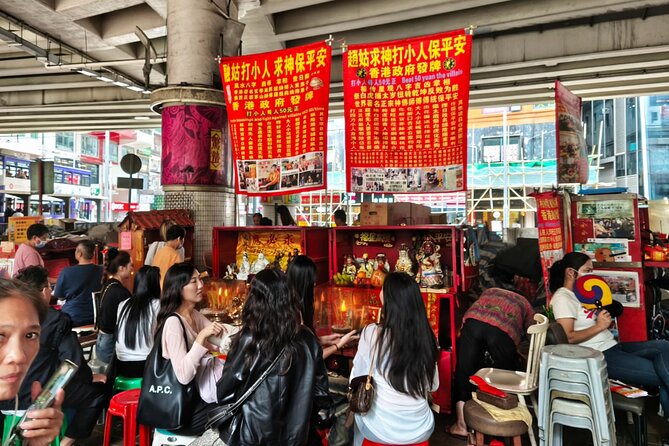
The most distinctive stop is Bowrington Villain Hitting, also called Gooseneck Bridge Villain Hitting. The ritual takes place beneath the Canal Road Flyover in Causeway Bay, where elderly women symbolically beat paper effigies to help clients ward off bad luck.
You may hear this described as a form of Cantonese folk ritual. The tour gives you a chance to see a custom that is easy to miss if you only visit major attractions. It also shows how modern infrastructure and older beliefs share the same urban space. Concrete flyovers carry traffic overhead, while a small ritual continues below.
Be respectful here. The instructions specifically ask visitors to remain polite and quiet around the ceremony. Avoid treating the ritual as a comedy act, and follow the guide’s directions about where to stand.
The stop may be memorable precisely because it does not fit the usual sightseeing pattern. It is not a grand building or an official museum. It is a living practice in an ordinary city setting. If your interest is limited to landmarks and skyline views, this may feel less important. If you want cultural context, it is one of the route’s best moments.
Monster Building in Quarry Bay
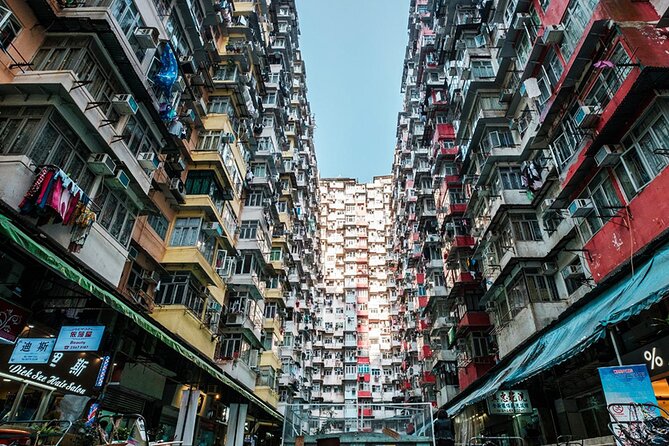
The final major sight is Monster Building, the nickname for Yick Cheong Building in Quarry Bay. Its tightly packed apartment façades create a dense wall of windows, balconies, and repeating units.
The building is a famous photo stop, but it is also a place where you should remember that people live there. Keep entrances clear, stay considerate, and follow the guide’s directions. The visual effect is powerful because it shows the pressure of urban housing in a very direct way.
Ending at MTR Quarry Bay Station is practical. You finish near a major transport link instead of being returned to Wan Chai, so you can continue around Quarry Bay or use the MTR for your next stop. The route therefore works well as an afternoon introduction to Hong Kong Island, especially if you have already seen the main harbor attractions and want a closer look at neighborhood life.
How much walking and standing should you expect?
The tour description says most people can participate, but it also warns that you should be able to stand for long periods. The route includes walking between cultural sites, moving through market areas, boarding and leaving the tram, and standing during parts of the experience.
People with limited mobility and families using baby strollers are not recommended for this tour. That is worth taking seriously. Even though the tram itself provides a seat at times, the day is not a seated sightseeing trip.
Wear light clothing and comfortable sports shoes. Hong Kong can feel hot and humid, and the route includes outdoor sections. Bring water, an umbrella, valid identification, and some cash. Keep your own belongings with you, since luggage storage is not provided and the operator does not accept responsibility for lost or damaged items.
The tour runs in changing city conditions. Weather, traffic, or unexpected events can alter the route. If a Typhoon Signal No. 3 or above is issued, the activity is canceled and a refund is provided.
Is $76.38 a fair price?
At $76.38 per person, this is not the cheapest way to ride a tram. A tram fare by itself costs far less. The real question is whether you want a guide to connect the ride with specific places, local customs, and neighborhood history.
I think the price makes more sense for first-time visitors who would otherwise pass through Wan Chai and Causeway Bay without understanding what they are seeing. The route combines the guide, tram fare, seven stops, cultural interpretation, and a pastry. You are also paying for the planning needed to connect sites spread across several districts.
The value is weaker if you already know Hong Kong Island well, prefer to explore at your own speed, or mainly want a scenic tram ride. You could visit many of these areas independently and spend less. The guided format earns its keep when you want context, especially at Blue House, Pak Tai Temple, and the villain-hitting site.
The tour is commonly booked about 31 days ahead, so reserve early if your dates are fixed. Confirmation arrives within 48 hours, subject to availability. The standard cancellation rule is strict: the experience is non-refundable and cannot normally be changed. If the operator cancels because of poor weather or insufficient participation, you are offered another date, another experience, or a full refund.
Who should choose this afternoon route?
I would recommend it to first-time visitors, culture-focused visitors, and anyone who wants a practical introduction to Hong Kong Island beyond postcard views. It suits people who enjoy moving between a temple, market, old apartment buildings, and a folk custom rather than spending the afternoon at one major attraction.
It also works for photographers who want Blue House, the old tong lau districts, Gooseneck Bridge, and Monster Building in one organized outing. The tram adds atmosphere and gives you a break from walking, though you should not expect a comfortable ride for the full duration.
Families with older children may enjoy the changing scenery and unusual villain-hitting ritual. Families with baby strollers should choose another activity. The same applies if you cannot stand for long periods or need a route with easy access at every stop.
Arrive before the 2:00 pm meeting time at Wan Chai MTR Station. The guide waits no more than 10 minutes, and late arrivals are responsible for catching up. Because one departure had to shift by about 90 minutes due to difficulties with a much larger morning group, avoid booking a tight evening reservation immediately afterward.
Should you book the Ding Ding tram tour?
Book it if you want context with your tram ride. The best parts are not only the famous photographs. They are the connections between restored buildings, working markets, Taoist worship, local folk practice, and dense modern housing.
Skip it if you want a fully relaxed, seated sightseeing trip or if your mobility makes frequent walking and standing difficult. At $76.38, the tour is a guided cultural route, not a bargain transport ticket. For the right visitor, its strength is the range of Hong Kong life packed into one afternoon, from Wan Chai’s Blue House to Quarry Bay’s Monster Building.
FAQ
Where does the tour start and finish?
The tour starts at MTR Wan Chai Station in Wan Chai at 2:00 pm and ends at MTR Quarry Bay Station in Quarry Bay.
How long does the experience last?
The tour lasts approximately 3 hours and 30 minutes.
Is the tour conducted in English?
An English or Chinese-speaking guide leads the experience.
What is included in the price?
The price includes the guide, Ding Ding tram fare, and a pastry.
What should I bring?
Bring valid identification, a water bottle, some cash, and an umbrella. Light clothing and comfortable sports shoes are recommended.
Is the tour suitable for people with limited mobility or baby strollers?
The tour is not recommended for people with limited mobility or families with baby strollers. Participants should be able to walk and stand for extended periods.
What happens if the tour is canceled because of bad weather?
If a Typhoon Signal No. 3 or above is issued, the activity is canceled and a refund is provided. For other poor-weather cancellations, you are offered a different date or a full refund.
Just added around Hong Kong
- Victoria Peak Tram and Sky Terrace 428 Admission Hong Kong★ 4.5 · 33 reviews
- Hong Kong Peak Tram and Sky Terrace 428 Tickets (Optional)★ 3.5 · 22 reviews
- HK Night Views: Victoria Peak Tram & Cruise Buffet Tour★ 4.0 · 7 reviews
- Day Tour to Shenzhen from Hong Kong by High Speed Bullet Train★ 5.0 · 6 reviews
- Hong Kong Island Orientation★ 5.0 · 6 reviews
- Tram & Treats – Private Culinary tour of Hong Kong★ 5.0 · 26 reviews
- Hong Kong: Fast Track Peak Tram & Big Bus Hop-On, Hop-Off★ 4.3 · 67 reviews
- Hong Kong: Victoria Peak Tram & Cruise Buffet Tour★ 4.3 · 23 reviews
Hong Kong Train Tours, compared.
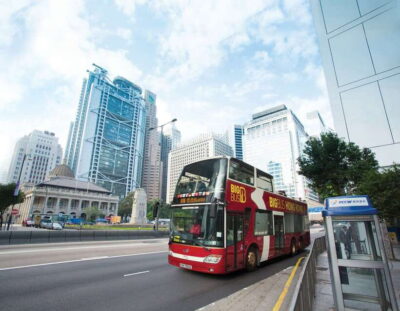
Big Bus Hop-On Hop-Off Tour & Optional Peak Tram
Read our review →
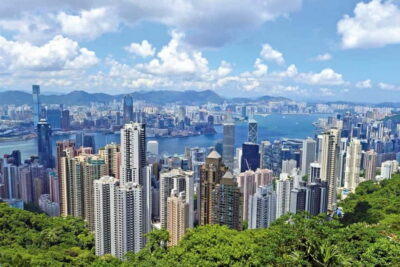
Hong Kong Day Tour: Priority Peak Tram, City Walk & Dim Sum
Read our review →
Top-Rated Hong Kong Tour: Peak Tram, Dim Sum & Cultural Sights
Read our review →
Victoria Peak Tram and Sky Terrace 428 Admission Hong Kong
Read our review →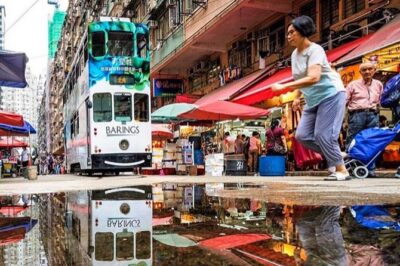
Tram & Treats – Private Culinary tour of Hong Kong
Read our review →Browse the lists this tour appears in