
REVIEW · WELLINGTON
Northern Explorer Train Journey from Wellington to Auckland
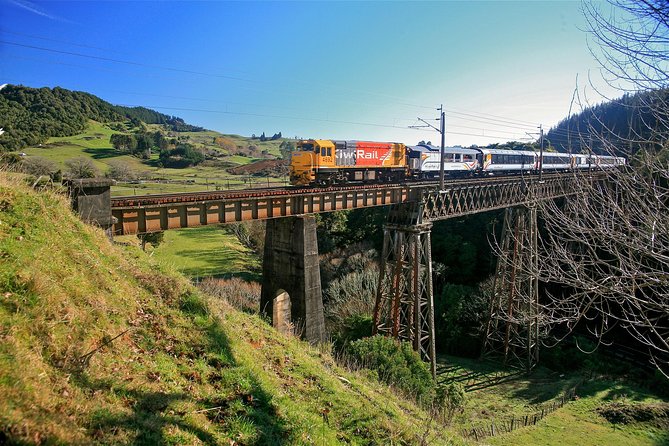
The most memorable part of this journey is the run through Tongariro National Park, where three volcanic peaks, old lava fields, beech forest, and snow can appear in one broad sweep. The train also crosses dramatic viaducts and works through the Raurimu Spiral, a clever piece of railway engineering that turns a steep route into a workable one.
I like the open-air viewing decks, which let you feel the wind and take clearer photos, and I like the relaxed pace. You can sit back, use the GPS-triggered commentary, and watch New Zealand roll past without worrying about narrow roads or driving on the left. The main drawback is simple: 11 hours is a long time, and the scenery becomes less dramatic later in the trip.
Key points before you book
- Tongariro’s volcanic peaks: Watch for Tongariro, Ngauruhoe, and Ruapehu across the Central Plateau.
- Open-air viewing decks: Great for fresh air and photos, but windy and not ideal for holding a camera steady.
- Onboard café: Snacks, light meals, and drinks are available for purchase, though you may find prices high.
- GPS audio commentary: Headphones at each seat provide location-based information as the train moves.
- A practical alternative to driving: You see much of the North Island without handling long roads or traffic.
- A full-day commitment: The scheduled journey takes about 11 hours and may feel excessive if your main goal is fast transport.
Wellington Station to the Kapiti Coast
Your day starts at Wellington Station on Bunny Street. The scheduled departure is 7:55 am, and you should arrive at least 20 minutes early to check in and receive your boarding pass. Have your booking voucher ready.
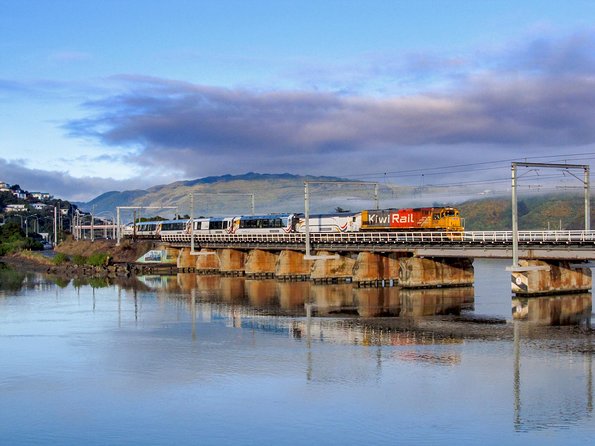
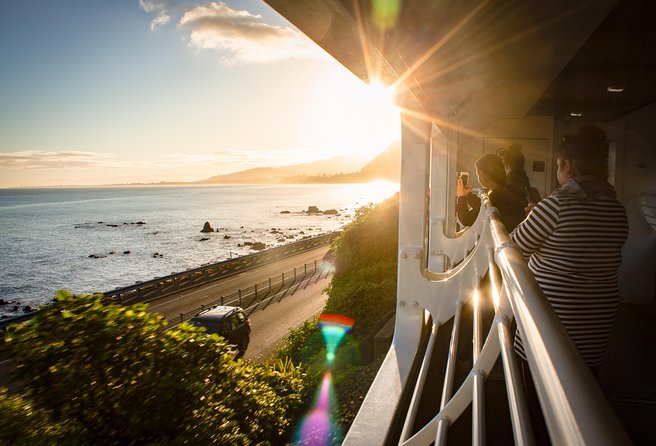
The early part of the route gives you a changing view of Wellington’s outskirts and the Kapiti Coast. Rocky shorelines, water, hills, and settled areas replace the city. I find this opening section useful because it eases you into the day rather than dropping you straight into the most dramatic scenery.
The train is designed for sightseeing. Large windows give you a wide view from your seat, and the specially designed seats provide a more comfortable base for a long ride. Several people have found the seats roomy and the train quiet enough for reading or simply watching the country pass.
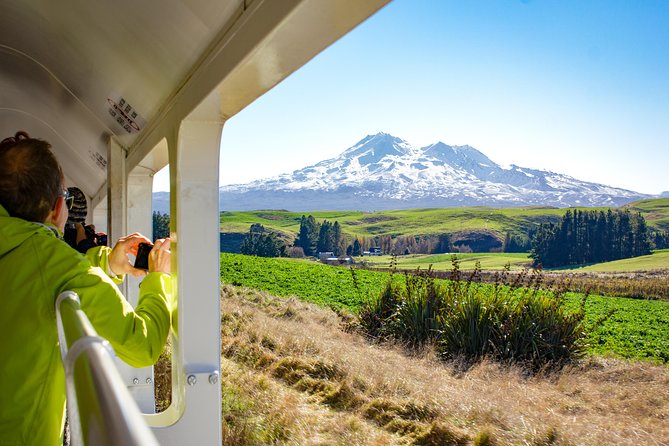
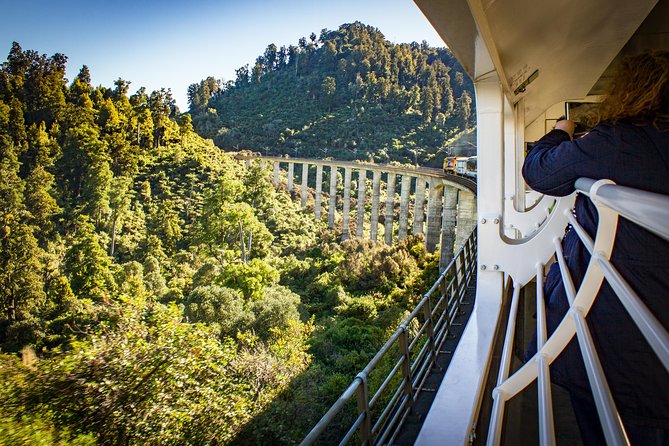
The open-air viewing carriage is worth visiting early in the day. It gives you a more direct view and helps with photography, but it is exposed to wind. Tall passengers may need to bend down in parts of the viewing area, and holding a camera steady can be difficult when the train is moving. Use it in short spells, then return to your seat when you want warmth and stability.
More Train Tours in New Zealand:
- Christchurch Hop-On Hop-Off Tram
★ 4.5 · 841 reviews - Christchurch Gondola and Tram City Tour Combo
★ 4.5 · 725 reviews - Christchurch: Hop-On Hop-Off Tour by Vintage Tram
★ 4.6 · 717 reviews
Through farmland and small country towns
As the train leaves the coast, the scenery shifts to rolling green farmland and small settlements. You will see a quieter side of the North Island, with fields, sheep, and broad rural views rather than major sights that demand a stop.
This is where the journey’s slow rhythm becomes its main benefit. You are not rushing from one attraction to another. You can read, chat, listen to the commentary, or simply watch the route unfold. I especially like this part for the sense of distance. You see how much country lies between Wellington and Auckland, something a flight removes entirely.
The GPS-triggered commentary adds useful context without requiring a guide to sit beside you. Audio begins as the train reaches different points, so you can follow the route while looking outside. It is worth using headphones, though a few passengers have had trouble with audio equipment. If your commentary cuts out, ask a staff member for help rather than missing the information for the rest of the day.
The train does not function like a hop-on, hop-off excursion. It is a continuous rail journey, so you should think of it as a moving viewpoint rather than a series of town visits. The value comes from seeing the route between places, not from spending time in each community.
The Central Plateau and Tongariro National Park
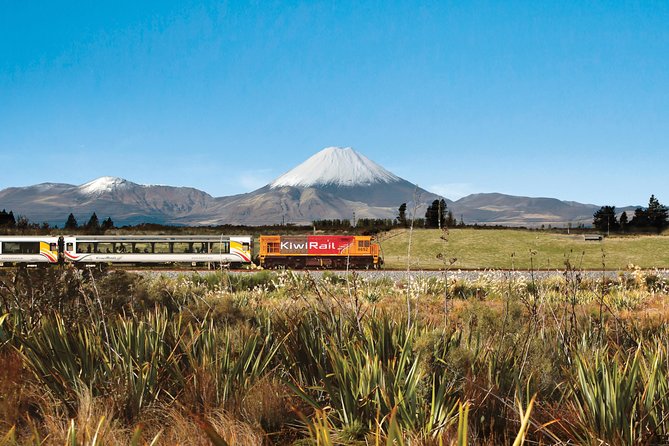
The strongest section arrives around the Central Plateau and Tongariro National Park. Here the scenery becomes larger and more unusual. Ancient volcanic activity has shaped the region, and you may see dark lava flows, forest, open fields, and snow around the same stretch of track.
The three main peaks are Tongariro, Ngauruhoe, and Ruapehu. Their appearance depends on cloud and weather, but when the views open, this is the part that justifies choosing the train over a quicker flight. The scale feels different from the coastal and farming sections. You are looking across a high volcanic area rather than along a settled shoreline.
I would keep your camera ready but avoid spending the whole time at the viewing deck. The best views may come through the large side windows, where you can watch comfortably and avoid the wind. The train may slow in spots that are good for photographs, but you should still expect brief opportunities rather than a long photo stop.
Weather matters here. Clear conditions can reveal the mountains and distant snow, while cloud can hide much of the drama. The experience requires good weather, and a cancellation caused by poor conditions may lead to a different date or a full refund. This is also why you should not judge the route only by photographs taken on bright days.
The Raurimu Spiral and the river gorges
Near National Park, the railway passes through the Raurimu Spiral. This is one of the route’s most interesting engineering features. The railway has to gain height through difficult country, so the track curves and loops instead of climbing in one straight line.
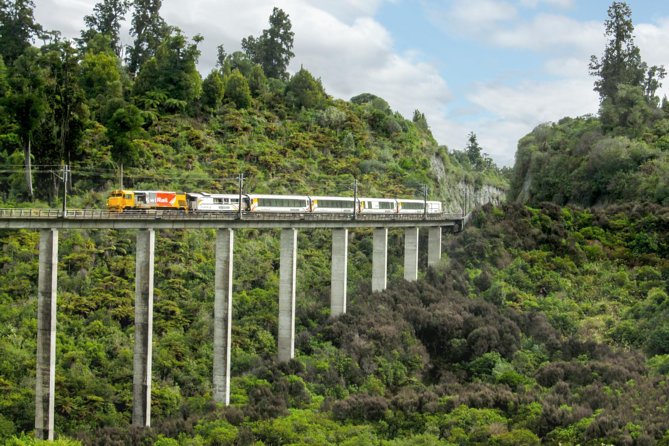
You will also pass through striking river gorges and over viaducts. The views can be hard to photograph from the open-air platform because of wind, movement, and the low viewing position. Still, this is a good time to leave your seat for a few minutes. The combination of steel railway, steep country, and open space gives the journey a strong sense of place.
The audio commentary helps here because the engineering is not always obvious from the window. Without explanation, you might see the train curve through the hills and miss why the route was built that way. The commentary turns a passing view into something you can understand.
This section is also a reminder that the Northern Explorer is not just a pretty ride. It is a working railway crossing difficult terrain. I like that balance. You get scenery, but you also get a clearer idea of the effort required to connect the North Island by rail.
Same tracks, a very different ride:
- Christchurch: Tram, Punt and Gondola Ride Combo Ticket
★ 4.7 · 608 reviews - TranzAlpine Train, Arthur’s Pass and Castle Hill Day Trip
★ 5.0 · 426 reviews - Coastal Pacific Train Journey from Picton to Christchurch
★ 4.5 · 345 reviews - TranzAlpine Train Journey: Christchurch to Greymouth
★ 4.5 · 312 reviews
Onboard comfort, food, and the viewing carriage
The train has a licensed café carriage serving snacks, light meals, and drinks. Alcohol is available to buy, and food and drinks are not included in the fare. The café is useful, but I would not treat it as a full restaurant unless your booking specifically includes a dining option.
Prices and quality can vary by item. Some passengers have found the food reasonably priced and good enough for a long day, while others have felt that certain items, including a croissant, were expensive. If you have particular dietary needs or want to keep spending down, bringing your own food may be the safer plan, provided current train rules allow it.
The seating is one of the stronger parts of the trip. Large windows, comfortable seats, and useful legroom make the long ride manageable. Toilets are available onboard, including an accessible toilet that has been praised for its design.
Air conditioning has been a concern on some journeys. Conditions inside the carriages may not always feel perfectly cool, so dress in layers. The viewing carriage is more exposed, while the main seating area is better for settling in with a book or headphones.
Staff service can make a real difference on an 11-hour trip. Conductor Bruce has been singled out for attentive care, and the onboard team helps passengers get sorted at the end of the journey. The tone is friendly rather than formal, which suits a long scenic ride.
Waikato countryside and the final hours
After the Central Plateau, the scenery gradually changes again. The route reaches the Waikato, with broad farmland and a more settled rural feel. This section is pleasant, but it does not have the same impact as the volcanic country.
This is where I would plan a change of pace. Use the later hours to read, nap, write notes, or review your photographs. You have already seen the strongest mountain views, and expecting constant drama will make the final stretch feel longer.
Several people have felt that the trip becomes less interesting around Hamilton and northward. That criticism is fair. The journey is not evenly spectacular from Wellington to Auckland. Its best sections are concentrated around the coast, Central Plateau, volcanic peaks, gorges, and viaducts.
The long duration also means this experience is not automatically the best transport choice. A flight will be much faster. The train makes sense when the journey itself is the point, when you dislike long-distance driving, or when you want a full day to see the North Island at ground level.
The train reaches Auckland at Strand in the Parnell area. Pay close attention to your final arrival instructions. Some bookings have not made it clear that a bus connection or transfer could be involved on the way into Auckland, and some passengers have been unsure about where to go after the rail portion. Check the details supplied with your booking before departure.
Is the $157.47 fare good value?
At $157.47 per person, this is not a cheap substitute for flying. You are paying for a full day of transport plus a sightseeing experience, not simply for the fastest way between two cities.
I think the fare offers reasonable value if you would otherwise rent a car, pay for fuel, and spend a day driving. You avoid the strain of long roads, unfamiliar traffic patterns, and driving on the left. You also get the mountain country, gorges, and farmland from a comfortable seat, with commentary and food available onboard.
The value is weaker if you need to arrive quickly or if you dislike long periods without stops. The journey lasts about 11 hours, and there are limited chances to stretch your legs away from the train. Food and drinks cost extra, and a café purchase can add up over the day.
Think of the fare as part transport and part sightseeing ticket. If you only compare it with a flight, it may look expensive. If you compare it with a private driving day and the chance to see the route without concentrating on the road, it becomes easier to justify.
Practical details that affect your day
The experience is listed with a maximum of 15 participants, though the train itself has shared seating and may feel full. You may sit opposite people you do not know. That is part of the social nature of a long rail trip, but it is worth expecting rather than assuming a private table.
Children must be accompanied by an adult. Service animals are allowed, and the station is near public transport. Most people can take part, but the long sitting time is worth considering if you have mobility concerns or need frequent breaks.
The booking is non-refundable and cannot be changed for any reason. That makes it important to check your date, passenger details, and Auckland arrival arrangements before paying. If poor weather causes the operator to cancel the journey, you may be offered another date or a full refund.
The experience is self-guided, which gives you freedom to spend the day as you wish. You do not have a tour leader directing every hour. Instead, staff, the audio system, and the scenery provide the structure.
Who should book the Northern Explorer?
I would choose this journey for someone who values the route more than speed. It suits photographers, rail fans, visitors who want to see the North Island without driving, and anyone who enjoys watching rural scenery change over a full day.
It also works well for a relaxed travel day between Wellington and Auckland. The seats, café, toilets, commentary, and viewing decks remove much of the hassle of a long transfer.
I would hesitate if you have only a short New Zealand visit, dislike sitting for long stretches, or mainly want to reach Auckland. You should also lower your expectations if you are looking for South Island style drama throughout the whole trip. The North Island has its own appeal, but the scenery varies, and the Waikato section is calmer.
Should you book this train journey?
Book it if you want the journey to be part of your New Zealand experience. Tongariro National Park, the Raurimu Spiral, the viaducts, and the open-air deck give you sights that a plane cannot provide, while the comfortable seating lets you enjoy them without driving.
Skip it if the 11-hour schedule feels like a burden or if your main goal is simply to move between Wellington and Auckland. For the right person, this is a memorable, low-stress way to cross the North Island. For everyone else, the length can outweigh the scenery.
FAQ
How long does the Wellington to Auckland train journey take?
The journey takes approximately 11 hours.
What time does the train depart from Wellington?
The scheduled departure time is 7:55 am from Wellington Station.
Where does the train leave from?
The departure point is Wellington Station on Bunny Street, Pipitea, Wellington.
Where does the journey finish in Auckland?
The listed arrival point is Auckland Strand in Parnell, Auckland.
Is food available on the train?
Yes. The train has a licensed café carriage serving snacks, light meals, and drinks for purchase. Food and drinks are not included in the fare.
Is there commentary during the journey?
Yes. GPS-triggered audio commentary is available through headphones at each seat.
Can I go outside during the journey?
Yes. The train has open-air viewing decks. They can be windy, and the viewing position may be less comfortable for tall passengers.
Can I cancel or change my booking?
No. The experience is non-refundable and cannot be changed for any reason. If poor weather causes the operator to cancel, you may be offered another date or a full refund.
Just added around New Zealand
- Wellington: Remutaka Rail Trail Cycle Tour★ 4.9 · 17 reviews
- Remutaka Rail Trail eBike Explorer Cycle Tour★ 5.0 · 11 reviews
- Remutaka Rail Trail- Wellington eBike Cruise Ship Shore Excursion★ 4.5 · 3 reviews
- Wellington Remutaka Rail Trail eBike Cycle Tour★ 5.0 · 23 reviews
- Remutaka Rail Trail Explorer – eBike Cruise Ship Shore Excursion★ 5.0 · 13 reviews
- Ultimate self-drive rail car journey★ 5.0 · 5 reviews
- Queenstown to Dunedin with Taieri Gorge Train One-Way Tour★ 5.0 · 5 reviews
- 2 Day West Coast Glaciers and TranzAlpine Train: Queenstown to Christchurch★ 3.0 · 3 reviews
Wellington Train Tours, compared.
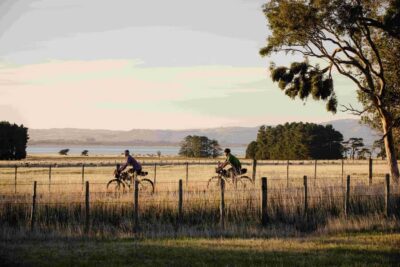
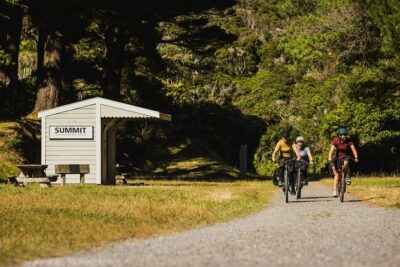
Remutaka Rail Trail Mountain Bike Explorer Cycle Tour
Read our review →Remutaka Rail Trail Mountain Bike Explorer Cycle Tour
Read our review →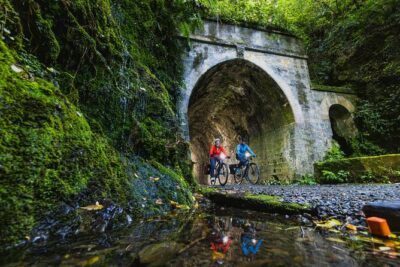
Wellington Remutaka Rail Trail eBike Cycle Tour
Read our review →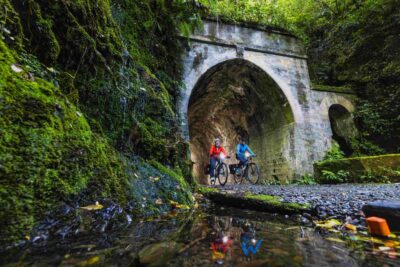
Remutaka Rail Trail Explorer – eBike Cruise Ship Shore Excursion
Read our review →
Remutaka Rail Trail eBike Shore Excursion for Cruise Ships
Read our review →Browse the lists this tour appears in