
REVIEW · NEW DELHI
Private Train Tour: 3-Day Golden Triangle Delhi, Agra, Jaipur from Delhi
The Taj Mahal is the star, but the clever part of this trip is how it links Delhi, Agra, and Jaipur without making you arrange every train, car, ticket, and hotel yourself. You see Mughal tombs, Sikh worship, Rajput forts, royal palaces, and modern India in a brisk three-day sweep.
I like the private format, since your group can adjust the pace or skip a stop. I also like the train sections, especially the early Delhi to Agra run, which saves road time and includes breakfast on board. The main drawback is simple: this is a packed schedule, with an early start on Day 2 and a late return to Delhi on Day 3.
Key points to know before booking
- Delhi begins with two UNESCO sites: Humayun’s Tomb and the Qutub Minar complex.
- The Delhi to Agra express train leaves around 6:00am, with breakfast served during the journey.
- The Taj Mahal and Agra Fort are both included, followed by a private road transfer to Jaipur.
- Jaipur’s main sights fit into one full day, including Amber Palace, City Palace, and Jantar Mantar.
- Private guides, station assistance, transfers, entrance fees, and bottled water remove much of the usual planning work.
- The $400 price depends on the selected hotel option, so check exactly what accommodation package you are choosing.
A fast but well-planned Golden Triangle route
India’s Golden Triangle works because the three cities offer very different experiences. Delhi gives you imperial avenues, Mughal monuments, and active religious life. Agra is the emotional center, with the Taj Mahal and the Mughal fort beside the Yamuna River. Jaipur then shifts the mood to Rajasthan, with sandstone forts, painted palaces, and astronomical instruments.
You cover all three cities in about 72 hours. That is enough for a strong first look, but not enough for a slow, unhurried visit. I would choose this tour if you have limited time in northern India and want someone else to handle the moving parts.
The private setup matters here. You travel by air-conditioned vehicle between sights and cities, then use fast trains for the Delhi to Agra and Jaipur to Delhi sections. Assistance at the rail stations is included, which is useful when you are managing luggage, unfamiliar platforms, and tight departure times.
Pick-up is offered from Delhi, Gurugram, and Noida. The stated start time is 9:00am on Day 1, but Day 2 begins much earlier, with the Agra train scheduled from about 6:00am to 8:00am. Your final day ends late, since the Jaipur train reaches Delhi around 10:40pm.
More Taj Mahal Train Day Trips in New Delhi:
- Taj Mahal Day Tour from Delhi by Superfast Train – TOP RATED TOUR
★ 5.0 · 4,166 reviews - Taj Mahal Tour from Delhi by Express Train (Viator Award Winner)
★ 5.0 · 2,849 reviews - From Delhi: Private Taj Mahal and Agra Tour by Express Train
★ 4.9 · 1,605 reviews
Day 1: Humayun’s Tomb and Delhi’s Mughal roots
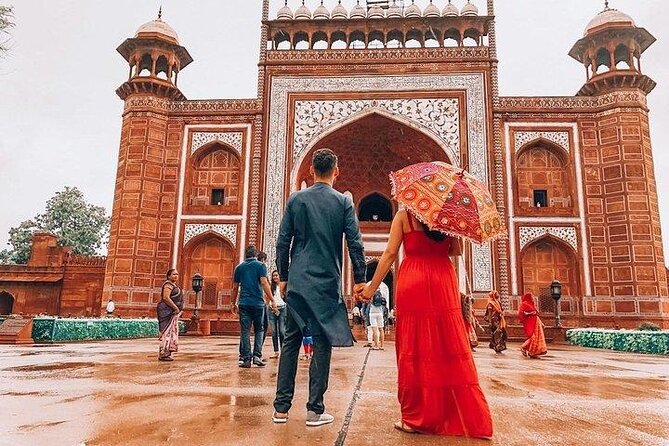
The first stop is Humayun’s Tomb, one of Delhi’s most graceful monuments. Built for the Mughal emperor Humayun, it rises above carefully arranged gardens in a formal charbagh design. Red sandstone, white marble, arches, and strict geometric planning give the building a calm order that can feel welcome after Delhi’s traffic.
You have about an hour here, with admission included. I would pay attention to the building’s proportions rather than rush straight to photographs. The tomb is also useful preparation for the Taj Mahal, since both belong to the Mughal tradition of monumental tomb architecture.
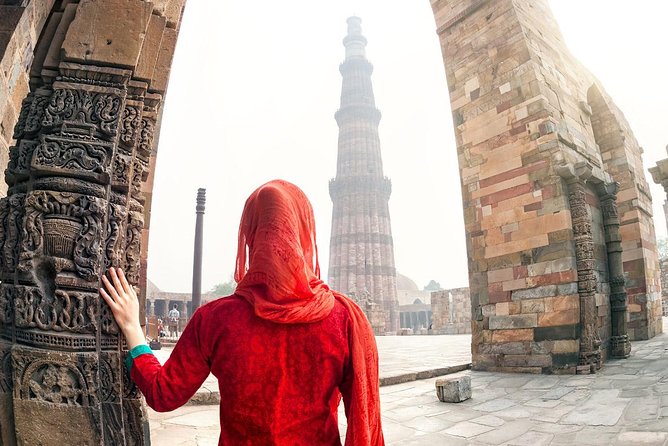
Next comes the Qutub Minar complex. Its central tower rises 73 meters and dates from the 12th century. The surrounding grounds hold ruined tombs, gateways, and other remains, so this is more than a quick stop beside a tall tower.
Again, the planned visit is about an hour and admission is included. The complex rewards a guide who can explain what you are seeing, since the ruins are spread around the main minaret and are easy to treat as background scenery. This is one of the places where a private tour gives you room to ask questions instead of following a fixed group pace.
A quieter Delhi at the Lotus Temple
The Lotus Temple offers a different kind of stop. Its 27 white marble petals form a modern building devoted to quiet worship and meditation. People of different faiths are welcome to sit silently, pray, or simply enjoy a pause from the city.
There is no admission charge, but the temple is closed every Monday. That detail matters because the rest of the schedule does not appear to offer much spare time for rearranging this visit. If your Day 1 falls on a Monday, confirm how the stop will be handled.
The visit is planned for about an hour. I like this inclusion because the Golden Triangle can otherwise become a nonstop march through monuments. The Lotus Temple gives you a chance to slow down and notice a living place of faith, not just another historic structure.
India Gate, central Delhi, and Gurudwara Bangla Sahib
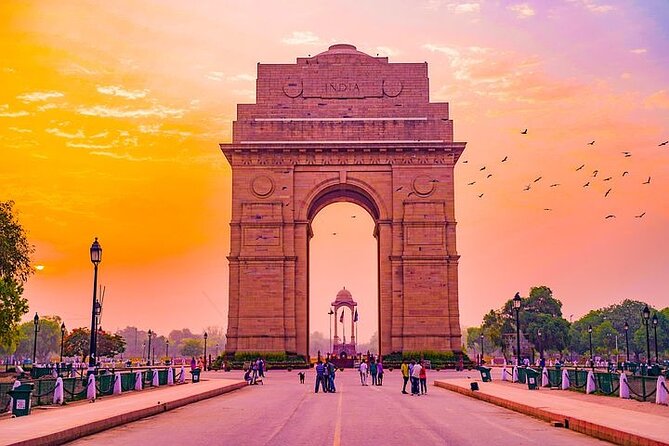
India Gate is a brief stop, planned for about 30 minutes. The 42-meter memorial honors about 90,000 Indian soldiers who died in World War I, the Northwest Frontier operations, and the 1919 Anglo-Afghan War.
The stop is mainly visual and contextual. You will see the arch and the broad central Delhi setting designed during the British period. Nearby, the route passes the circular Parliament building and Rashtrapati Bhavan, the President’s House. These are viewed as part of the drive rather than listed as full interior visits, so do not expect a detailed palace tour.
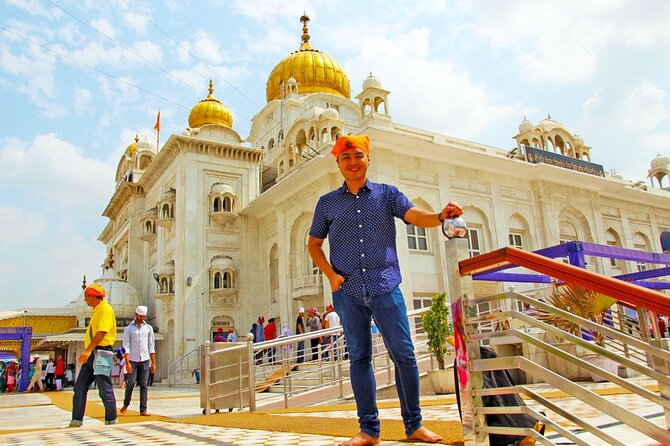
Gurudwara Bangla Sahib closes the day on a more personal note. This white marble Sikh temple has golden domes, devotional singing, and a calmer feel than the major roads outside. It was built at the site where the eighth Sikh guru, Harkrishan Dev, stayed before his death in 1664.
The gurdwara is also a working religious center. Free meals are served daily to pilgrims, though this tour does not promise that you will eat there. Dress and behavior should be respectful, and your guide can help explain what is happening. The scheduled visit is about an hour, with no admission fee.
More Three-Day Trips in New Delhi:
- 3-Day Tour to Khajuraho and Kamasutra Temple from Delhi by Train
★ 3.0 · 2 reviews - 3-Day Isle of Skye, ‘Hogwarts Express’ Train and Highlands Tour
★ 5.0 · 972 reviews - 3-Day Blarney Castle, Ring of Kerry, & Cliffs of Moher Rail tour
★ 4.5 · 211 reviews - Edinburgh: Isle of Skye & Optional Jacobite Train 3-Day Tour
★ 4.7 · 191 reviews
Day 2: The express train to Agra
The train from Delhi to Agra is one of the practical strengths of the route. It is scheduled for roughly 6:00am to 8:00am, with breakfast served on board. You avoid a longer road transfer and get a look at the countryside from the carriage window.
The early departure is also the day’s main challenge. You need to be ready well before a normal sightseeing start, and your energy will matter later at the Taj Mahal and Agra Fort. Station assistance is included, which should make the early connection less stressful.
On arrival, you meet a local guide at the main exit gate. That handoff is useful because Delhi and Agra are handled as separate parts of the trip. You do not have to search for a driver or guide after stepping off the train.
The Taj Mahal: allow the moment to work
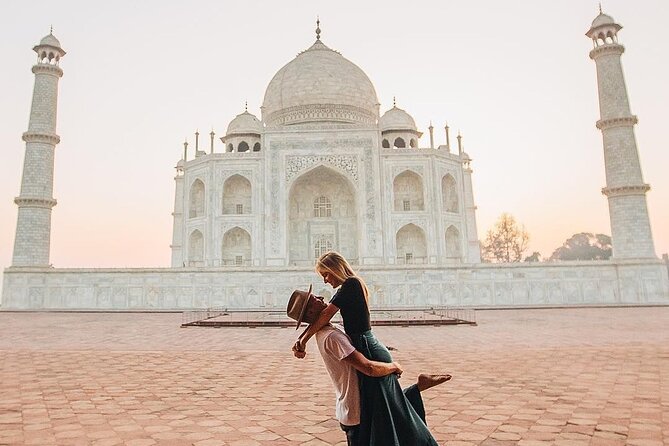
The Taj Mahal deserves the two hours assigned to it. Shah Jahan built it as a memorial for his wife Mumtaz Mahal, who died in 1631 after giving birth to their 14th child. The building’s white marble, balanced gardens, and changing light explain why it is often treated as the defining sight of northern India.
Your admission fee is included, as is a battery bus or e-rickshaw ride between the parking area and the monument. That short transfer matters because vehicles do not simply pull up at the main entrance.
Two hours is a sensible minimum. You need time for the approach, security, the main terrace, views across the gardens, and the interior areas allowed during your visit. The site can feel crowded, and the private guide cannot change that, but a private visit does let you pause where you want and ask about the design, the marble work, and the story behind the monument.
Agra Fort and the road to Jaipur
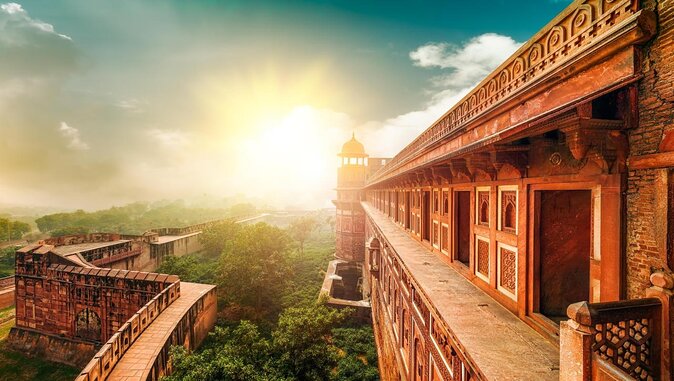
Agra Fort gives you the political side of Mughal history after the emotional focus of the Taj Mahal. The red sandstone fort beside the Yamuna served as the main residence of Mughal emperors until 1638. Its walls enclose palaces, audience spaces, and courtyards, with views toward the river and, in suitable conditions, the Taj Mahal.
The planned visit is about an hour, with admission included. That is enough for the principal areas, though not for every corner of the large complex. I would ask your guide to focus on the sections that best explain how the fort worked as both a military structure and a royal residence.
After Agra Fort, you drive to Jaipur. The transfer is listed at about five hours, though exact timing depends on traffic. This is the longest road segment of the tour, and it can feel tiring after an early morning and two major sights.
Once in Jaipur, you check into the pre-booked hotel. Two nights of accommodation with breakfast are included if you select the option that includes hotels. Read the booking choice carefully, since the price and inclusions depend on that selection.
Day 3: Amber Palace and Jaipur’s royal sights
After breakfast, you check out and head to Amber Palace, also called Amer Fort. It sits about 11 kilometers northeast of Jaipur on a rocky mountainside and combines pale yellow and pink sandstone with white marble.
The complex is arranged in four main sections, each with its own courtyard. The two-hour visit gives you time to see the courtyards, gateways, palace rooms, and elevated setting. Amber is one of the strongest stops on the entire trip because it presents Rajput architecture on a large scale, rather than as a single palace facade.
An elephant or jeep ride at Amber is not included. That is worth noting before you arrive, since some visitors expect an animal or vehicle ascent to be part of a fort visit. The tour provides the sightseeing visit, but any such ride would be an extra choice and cost.
Jal Mahal comes next as a short photo stop. The Water Palace sits in Man Sagar Lake and has an almost unreal appearance from the shore. You have about 15 minutes, so treat it as a scenic pause rather than a palace visit. You do not go inside.
Hawa Mahal, City Palace, and Jantar Mantar
Hawa Mahal is Jaipur’s most recognizable facade. Built in 1799, the five-story pink structure has a honeycomb of small windows that allowed women of the royal household to watch city processions without being seen.
This is another 15-minute photo stop. Admission is not included, and the schedule does not present it as an interior visit. You should expect a view from outside, with limited time for photographs.
City Palace receives a fuller hour. It remains the residence of Jaipur’s royal family and includes courtyards, gardens, and buildings from different periods. The architecture blends Rajasthani and Mughal features, making this a useful counterpoint to the Mughal sites in Delhi and Agra.
The final major sight is Jantar Mantar, a UNESCO-listed observatory built from large geometric instruments. These structures were designed to track the movement of stars and planets. The shapes can look abstract at first, so a guide is especially helpful here. The included one-hour visit turns unusual stone forms into a practical lesson in astronomy.
Returning to Delhi by train
The Jaipur to Delhi train is scheduled for approximately 5:50pm to 10:40pm, with dinner served on board. This saves you from another long road journey and lets you rest after a full day of sightseeing.
At Delhi station, a representative meets you and arranges the final drop-off to a destination in Delhi, Gurugram, or Noida. Door-to-door handling is one of the service team’s strongest practical features. Driver DK Shwarma is specifically associated with the operation, and station support is provided for both rail legs.
The late arrival makes Day 3 a long one. If you have a flight the next morning, confirm your hotel location and departure time before booking. The tour finishes at your requested drop-off point, but you should not plan a late-night activity after arrival.
What the $400 price really covers
At $400 per person, the value depends on whether your selected package includes the two hotel nights. With the hotel option, the price covers accommodation on a twin-sharing basis, breakfast, private vehicle transport, guides, train tickets, entrance fees, station assistance, bottled water, and selected train meals.
Breakfast is included during the Delhi to Agra train ride, and dinner is included during the Jaipur to Delhi ride. Two hotel breakfasts are also listed. Other food and drinks are not included, so you should budget for meals in between.
The private vehicle and guides are where much of the value lies. You are not simply buying rail tickets and a hotel room. You are paying to connect several moving parts across three cities, with monument admission and local guiding already arranged.
There are still extras. Camera fees at monuments are excluded. The Amber elephant or jeep ride is excluded. A mandatory gala dinner at the hotel on Christmas Eve or New Year’s Eve is also extra. Ask about those costs before confirming a festive-season booking.
Who should book this three-day trip?
I would choose this tour for a first visit to northern India when time is tight and convenience matters. It suits couples especially well because the private car, private guides, and Taj Mahal visit create a more personal trip than a large shared coach.
It also works for families and small groups who want flexibility. You can alter the plan or skip a stop, according to the service details provided. That option is valuable on a demanding route, since not everyone in a group will want the same amount of time at every monument.
I would hesitate if you prefer slow travel. Delhi, Agra, and Jaipur each deserve more than a day, and this plan gives you only a short taste of each. The early train, five-hour transfer, full Jaipur day, and late return to Delhi require stamina.
The private format also means the experience depends on the guide assigned in each city. The arrangement includes professional local guides for all sightseeing, but guide names are not provided in advance. If a particular guide or language matters to you, ask before booking.
Final verdict: a strong first look, with a fast pace
Book this tour if you want the Golden Triangle’s essential sights with rail tickets, private transport, guides, hotels, and entrance fees handled in one package. The route is efficient, and the train journeys break up the long distances better than an all-road trip.
Skip it if you want lingering mornings, long meals, or unplanned time in Jaipur’s markets and neighborhoods. The best reason to book is the combination of private service and logistics support. The main price you pay is not money, but time: three famous cities in three very full days.
The cancellation terms are worth noting before you commit. You can receive a full refund only if you cancel at least three full days before the local start time. A valid passport is required, and passport details are needed when booking.
FAQ
Where does the tour start and finish?
Pick-up is available from a desired location in Delhi, Gurugram, or Noida. After the Jaipur to Delhi train, a representative meets you at the Delhi railway station and arranges drop-off at a destination in Delhi, Gurugram, or Noida.
What time does the tour begin?
The stated start time is 9:00am on Day 1. Day 2 has an early train from Delhi to Agra, scheduled for approximately 6:00am to 8:00am.
Are hotel nights included?
Two hotel nights with breakfast are included when you book the option that includes hotels. Check the selected package carefully because accommodation is tied to that booking option.
Are meals included?
Breakfast is served on the Delhi to Agra train, and dinner is served on the Jaipur to Delhi train. Two hotel breakfasts are also listed. Other food and drinks are not included unless specified.
Is the Lotus Temple open every day?
No. The Lotus Temple is closed every Monday. Admission is free when it is open.
Are the Amber Fort elephant or jeep rides included?
No. Any elephant or jeep ride at Amber Fort is excluded from the tour price.
Just added around New Delhi
- Same day Agra tour from Delhi by express train★ 5.0 · 5 reviews
- Taj Mahal by Superfast Train Gatimaan Express★ 5.0 · 3 reviews
- Private Tour of Taj mahal from Delhi by Train in 90 Min★ 5.0 · 46 reviews
- All Inclusive Luxury Taj Mahal Tour from Delhi by Express Train★ 5.0 · 51 reviews
- Private Tajmahal Day Tour From New Delhi By Gatiman Express Train★ 5.0 · 14 reviews
- Taj Mahal and Agra Fort tour By Superfast Train from Delhi★ 4.5 · 3 reviews
- Taj Mahal same day luxurious Tour by Superfast Train from Delhi★ 5.0 · 27 reviews
- Overnight Taj Mahal and Agra Private Tour by Train from Delhi★ 5.0 · 6 reviews
New Delhi Train Tours, compared.
Taj Mahal Tour from Delhi by Express Train (Viator Award Winner)
Read our review →
Taj Mahal, Agra Fort, Baby Taj Tour from Delhi by Superfast Train
Read our review →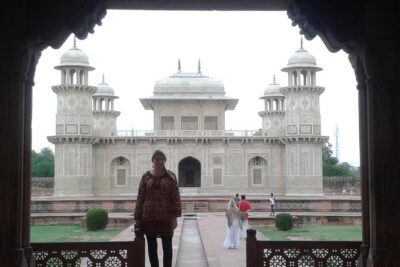
Delhi to Agra and Taj Mahal Private Day Trip by Express Train with Lunch
Read our review →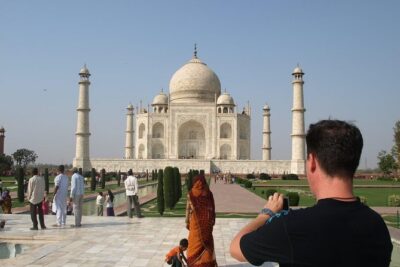
Taj Mahal & Agra Tour by Gatimaan Express Train
Read our review →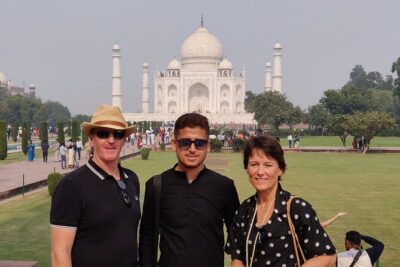
All Inclusive Taj Mahal & Agra Tour by Superfast Train From Delhi
Read our review →
Delhi to Agra Taj Mahal Private Day Trip by Superfast Train
Read our review →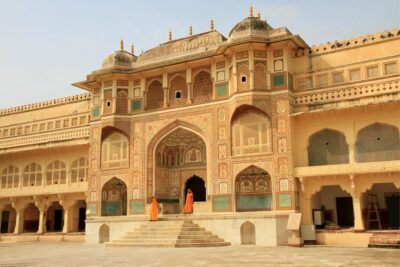
Jaipur Day Trip from Delhi by Car or Train – All Inclusive
Read our review →
Private Taj Mahal & Agra Day Tour by Superfast Train From Delhi
Read our review →Browse the lists this tour appears in