
REVIEW · NEW ZEALAND
Northern Explorer Train Journey from Auckland to Wellington
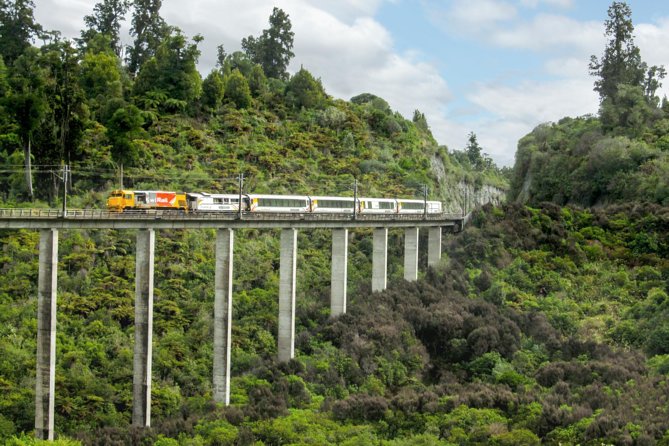
The Northern Explorer’s best feature is simple: it lets you see New Zealand’s North Island at ground level, at a pace that gives the scenery time to change. You roll from Auckland’s suburbs through green Waikato farmland, volcanic country, river gorges, and the coast south of Wellington. The highlight is Tongariro National Park, where snow, lava, forest, and three volcanic peaks can appear in one wide view.
I like the open-air viewing deck, which gives you fresh air and unobstructed photos, and the comfortable seating with generous legroom. GPS-triggered commentary helps explain what you are seeing, while the café carriage keeps the long ride manageable. The catch is the length: this is an 11-hour journey, and service changes or delays have occasionally made it longer.
You should also confirm the departure arrangements before leaving for the station. Auckland service has sometimes involved a bus to Hamilton because of planned rail maintenance, with poor communication leaving some passengers confused. That is not the usual romantic picture of train travel, but it is a real practical concern.
Key points to know before you book
- The journey lasts about 11 hours: This is a full-day trip, not a quick transfer between Auckland and Wellington.
- Tongariro National Park is the scenic high point: Look for Mount Tongariro, Mount Ngauruhoe, and Mount Ruapehu, plus old lava flows and beech forest.
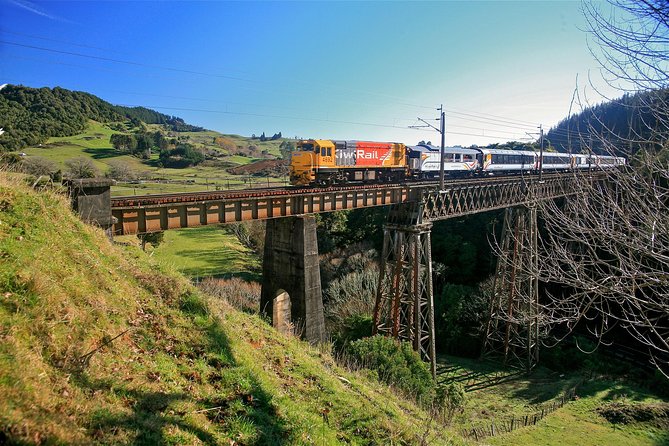
- The Raurimu Spiral is a railway engineering marvel: The train curls through tight curves, tunnels, and viaduct country near National Park.
- The open-air carriage is worth using: It gives you fresh air and clear photos, but bring a jacket and expect changing conditions.
- Food is available, not included: The licensed café sells snacks, drinks, coffee, and light meals. A few passengers find the service slow when the carriage is busy.
- Seat choice may matter: Some bookings do not let you select a seat, and backward-facing or four-person table seats may feel less comfortable over 11 hours.
Why this train journey is worth your day
Flying from Auckland to Wellington is faster. Driving gives you more control. Yet neither option gives you the same easy view of the North Island, with no need to watch traffic or plan every turn.
I like the way the Northern Explorer turns a transfer into part of the holiday. You can read, talk, watch the GPS commentary, visit the café, or step onto the viewing deck. The scenery keeps changing slowly enough for you to notice the shift from city to pasture, from pasture to volcanic country, and from high plateau to coast.
This is not a luxury rail journey with a private cabin or a formal dining service. Think of it as a comfortable scenic train with large windows, a café carriage, and room to move around. That distinction matters. At $164.45 per person, the fare is reasonable if you value the journey itself. It is less attractive if you only need to get from one city to the other as quickly as possible.
The overall rating is 4.2 from 204 ratings, which fits the experience well. The scenery, seating, staff, and viewing deck earn strong praise, while the long duration, occasional delays, changing departure arrangements, and uneven communication keep it from being perfect.
More Train Tours in New Zealand:
- Christchurch Hop-On Hop-Off Tram
★ 4.5 · 841 reviews - Christchurch Gondola and Tram City Tour Combo
★ 4.5 · 725 reviews - Christchurch: Hop-On Hop-Off Tour by Vintage Tram
★ 4.6 · 717 reviews
Auckland departure: arrive early and check the platform details
The listed starting point is Auckland Strand in Parnell, with a scheduled departure at 7:45 am. You should arrive at least 20 minutes early to check in and receive your boarding pass. Early arrival is especially sensible here because station arrangements have not always been straightforward.
At times, the Northern Explorer has not begun its rail journey from Auckland. Instead, a bus has carried passengers from Auckland to Hamilton, where they boarded the train. This has been linked to known maintenance on the Auckland line rather than bad weather. The issue is not the bus itself. The problem is finding out about it only after reaching the station.
Check your confirmation and current service information carefully before departure. If the Auckland to Hamilton section is by bus, allow extra patience and do not expect the day to follow the usual train-only pattern. This is one of the few parts of the trip that can undermine the otherwise easygoing feel.
Once on board, the train settles into its rhythm. Seats are specially designed for a long ride, and several people praise the legroom and broad windows. Still, an 11-hour seat is an 11-hour seat. Plan to get up regularly, visit the café, and spend time on the open-air deck.
Waikato farmland and the first change of scenery
The early part of the journey moves through the Waikato, a region of broad pasture, rolling green fields, and small country communities. It is not one continuous parade of famous sights. You will also pass towns, roads, utility lines, and ordinary working farmland.
That is part of the appeal. The train shows you the everyday North Island rather than only its postcard views. You see how quickly Auckland’s urban edge gives way to open country, and you get a sense of the distance between the two major cities.
The GPS-triggered audio commentary adds useful context at points of interest. Headphones are available at every seat. It is worth listening when the commentary begins, but you do not need to keep it running for the entire day. The quiet stretches are pleasant too.
The windows are the main viewing tool during this section. Keep your camera ready, but do not spend the whole morning staring through a screen. The best reward is watching the colors and terrain shift as the train heads south.
The central plateau and three volcanic mountains
The strongest part of the route arrives as the train reaches Tongariro National Park. This is the scenery that justifies taking the train instead of flying.
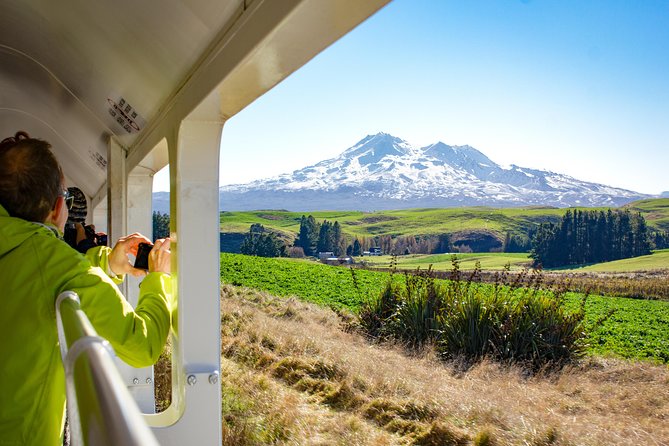
The park is marked by three major volcanic mountains: Tongariro, Ngauruhoe, and Ruapehu. Their appearance depends heavily on weather and season. On a clear day, you might see snow-covered slopes, dark volcanic rock, old lava flows, and patches of beech forest in the same broad view. Cloud can hide the peaks, so keep your expectations flexible.
Mount Ruapehu is often the great visual prize, especially when its summit is snow-covered. The volcanic setting feels very different from the soft farmland earlier in the morning. The change is dramatic without being rushed, which gives you time to understand the scale of the central plateau.
The train does not stop for a long sightseeing visit in the national park. You are seeing it from the carriage, so this is not a substitute for hiking or spending several days in the region. It is, however, an excellent introduction if your wider New Zealand trip does not include time here.
For the best view, watch both sides of the train rather than settling in one window. Seating arrangements are assigned, and you may not be able to choose the side you prefer. The open-air carriage helps solve that problem, allowing you to look in several directions and take photographs without glass reflections.
Same tracks, a very different ride:
- Christchurch: Tram, Punt and Gondola Ride Combo Ticket
★ 4.7 · 608 reviews - Northern Explorer Train Journey from Wellington to Auckland
★ 4.0 · 513 reviews - TranzAlpine Train, Arthur’s Pass and Castle Hill Day Trip
★ 5.0 · 426 reviews - Coastal Pacific Train Journey from Picton to Christchurch
★ 4.5 · 345 reviews
The Raurimu Spiral and the railway’s cleverest section

Near National Park, the train works through the Raurimu Spiral, one of the most memorable engineering features on the route. The railway uses tight curves, tunnels, and changes in elevation to handle difficult country that could not be crossed by a simple straight line.
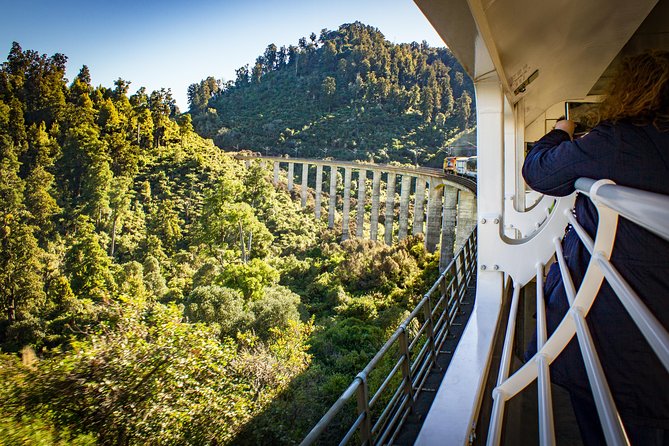
You may not grasp the full shape of the spiral from your seat. The experience comes from feeling the train curve and climb through the hills, then noticing how the track manages the steep terrain. The route also includes striking river gorges and several viaducts.
This is a good time to listen to the audio commentary, then step outside if conditions are comfortable. The open-air viewing deck can be busy when a major sight approaches, so do not wait until the last minute to leave your seat.
The deck is one of the train’s most useful features, but it is not a warm indoor observation room. Bring a jacket or sweater. Conditions can change quickly, and one section of the train may feel warm while another feels cool. Also take care near the carriage behind the open-air section, which can become uncomfortably hot according to one account.
From river gorges to the Kapiti Coast
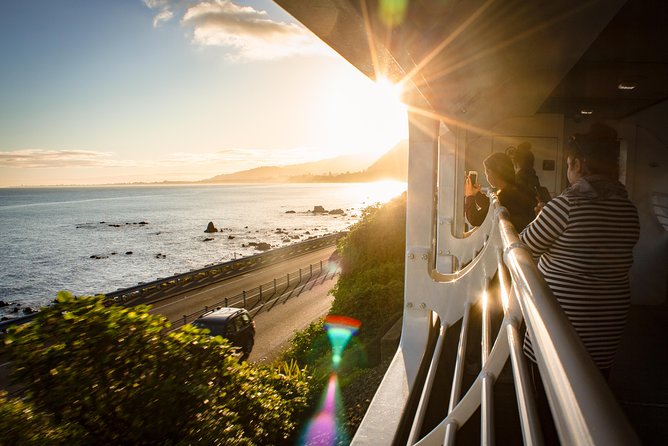
After the central plateau, the route gradually leaves the volcanic interior and heads toward the lower North Island. You pass through more towns, farmland, and river country before reaching the coast near Wellington.
The Kapiti Coast gives the final part of the journey a different mood. After the high country, the appearance of the sea and rocky coastal stretches makes a welcome change. The train follows a route that lets you watch the country open out again before the final approach to Wellington.
This is also the point when the length of the ride becomes most noticeable. Some people find the day passes quickly because there is always something to watch, while others are ready to arrive well before Wellington. Both reactions are fair.
You should plan for an arrival around the early evening, but do not treat the advertised time as guaranteed. A scheduled arrival around 6:25 pm has, on occasion, become closer to 7:15 pm. Weather, rail conditions, maintenance, and operational problems can all affect a long train service.
Seats, carriage comfort, and the open-air deck
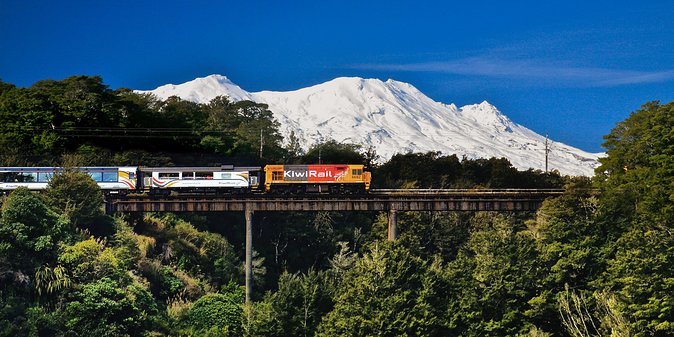
The seating is one of the Northern Explorer’s strongest features. The carriages are designed for scenic rail travel, with large windows, comfortable seats, and good legroom. You can sit back without the cramped feeling found on some buses or short-haul aircraft.
Still, not every seat arrangement is equally pleasant. A four-seat grouping can feel tight, especially if you are facing backward or sharing a table with another couple. Since some bookings do not allow seat selection, you may not get the arrangement you imagined.
If facing backward bothers you, ask about seat selection before booking. Do not assume a third-party booking will provide the same choices as booking directly. This small detail can make a big difference over 11 or 12 hours.
The open-air viewing carriage is the train’s signature feature. You can step outside, feel the air, and take photographs without a window between you and the view. It is especially useful for wide scenes, viaducts, volcanic peaks, and quick changes in weather.
Use it in short visits rather than trying to stay there all day. The wind, temperature, and crowds can wear you down. A good pattern is to watch from your seat, move outside when a notable section approaches, then return to the quieter carriage.
Café food, drinks, and what to pack
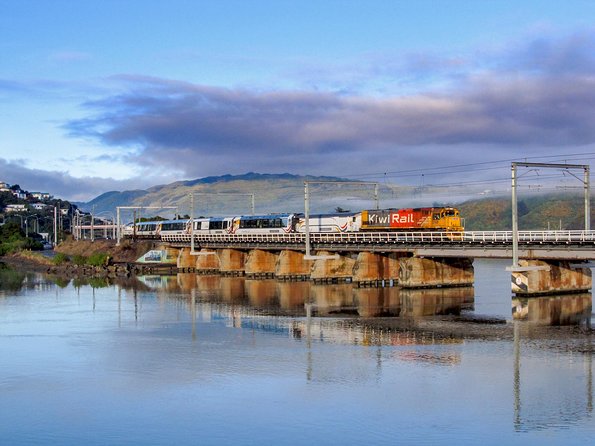
Food and drinks are not included in the fare, but all trains have a licensed café carriage selling snacks, coffee, drinks, and light meals. Alcohol is also available to buy. You can bring your own snacks, which is a sensible idea for a day this long.
The food receives mixed but generally positive reactions. Some passengers find the meals and coffee better than expected, while others describe the menu as basic. Service can slow down when the café is busy because the carriage may be understaffed.
Do not board expecting a restaurant experience. Think of the café as a practical way to break up the journey. Bring a few favorite snacks, water, and anything you need for your own comfort. Then use the café for a hot drink, a light meal, or a change of scenery.
The café carriage also gives you a reason to walk around. That matters on a long ride. Even a short trip from your seat to the food counter can help the day feel less static.
Commentary, Wi-Fi, and onboard entertainment
GPS-triggered commentary is available through headphones at every seat. It helps point out places along the route and gives the passing scenery more meaning. The commentary is most useful when you want to understand the railway, towns, park, and engineering features rather than simply watch the view.
Wi-Fi has not always worked as promised. Do not rely on it for the whole journey. Download anything you want before boarding, and consider bringing a book or other offline entertainment.
The long ride also creates an unusually social setting. You can talk with people from different backgrounds, share a table, or simply watch the country pass by. One onboard quiz has been described as fun, but you should treat that as a possible extra rather than a guaranteed scheduled feature.
The staff are generally a bright spot. Names are not provided for the whole crew, though one passenger specifically praised Tia for attentive service. Friendly, helpful staff can make a difference when the train is full, the café is busy, or the day runs late.
Price, timing, and practical value
At $164.45 per person, this is not the cheapest way to move between Auckland and Wellington. A flight saves most of a day. A rental car may offer more freedom, especially if you plan to stop in smaller places.
The train earns its fare by turning the distance into a scenic day out. You get a comfortable seat, the commentary, the viewing deck, and the chance to see parts of the North Island you would miss from the air. You also avoid the strain of driving for hours.
For me, the value depends on your goal. If the journey itself is part of your holiday, the price is fair. If Wellington is simply the next stop and time is tight, flying may be the better use of your money and energy.
The service is listed for a maximum of 15 participants in the booked activity, though the train itself is a larger public rail service. Children must be accompanied by an adult, service animals are allowed, and most people can take part. Hotel pickup and drop-off are not included, so you must reach Auckland Strand and make your own arrangements after arriving at Wellington Station on Bunny Street.
The booking is non-refundable and cannot be changed for any reason. Because of that strict condition, check the date, departure details, and any planned connections before paying.
Who should take the Northern Explorer?
I would recommend this train to anyone who sees transport as part of the holiday. It suits people who enjoy scenery, photography, railways, quiet observation, and a slower pace. It is also useful for anyone who wants to see the North Island without driving.
Families can enjoy the viewing deck and changing scenery, though younger children may find 11 hours difficult. Older passengers may appreciate the comfortable seats and freedom to move around, but should plan regular breaks.
This is not the right pick if you dislike long journeys, need a firm arrival time, or become uncomfortable in assigned seating. It is also a poor choice if you expect a luxury dining train or a perfectly controlled schedule.
Should you book it?
Book the Northern Explorer if you want to cross New Zealand by rail rather than simply arrive in Wellington. The Tongariro section, Raurimu Spiral, open-air deck, and comfortable windows make the long day worthwhile for many people.
Before booking, accept three facts: the ride may last longer than 11 hours, seat selection may be limited, and Auckland service may sometimes include a bus to Hamilton. Bring snacks, a jacket, offline entertainment, and patience.
If those conditions sound manageable, this is a memorable way to see the North Island at a human pace. If you only need fast, dependable transport, take a flight and spend the saved hours exploring at your destination.
FAQ
How long does the Northern Explorer journey take?
The journey takes approximately 11 hours from Auckland to Wellington. Delays can make the day longer, so you should allow extra time after the scheduled arrival.
Where does the train leave from in Auckland?
The listed departure point is Auckland Strand in Parnell, Auckland 1010. The scheduled departure time is 7:45 am.
Where does the journey end in Wellington?
The service ends at Wellington Station on Bunny Street, Pipitea, Wellington 6011.
How early should I arrive at the station?
You should arrive at least 20 minutes before departure to check in and receive your boarding pass.
Is food included in the ticket price?
No. Food and drinks are available to purchase in the licensed café carriage. Alcoholic drinks are also available to buy.
Does the train have an open-air viewing area?
Yes. The train has an open-air viewing deck where you can see the scenery without looking through a window.
Is audio commentary available?
Yes. GPS-triggered audio commentary is available through headphones at every seat.
Can I cancel or change the booking?
No. This experience is non-refundable and cannot be changed for any reason.
Just added around New Zealand
- Wellington: Remutaka Rail Trail Cycle Tour★ 4.9 · 17 reviews
- Remutaka Rail Trail eBike Explorer Cycle Tour★ 5.0 · 11 reviews
- Remutaka Rail Trail- Wellington eBike Cruise Ship Shore Excursion★ 4.5 · 3 reviews
- Wellington Remutaka Rail Trail eBike Cycle Tour★ 5.0 · 23 reviews
- Remutaka Rail Trail Explorer – eBike Cruise Ship Shore Excursion★ 5.0 · 13 reviews
- Ultimate self-drive rail car journey★ 5.0 · 5 reviews
- Queenstown to Dunedin with Taieri Gorge Train One-Way Tour★ 5.0 · 5 reviews
- 2 Day West Coast Glaciers and TranzAlpine Train: Queenstown to Christchurch★ 3.0 · 3 reviews
New Zealand Train Tours, compared.
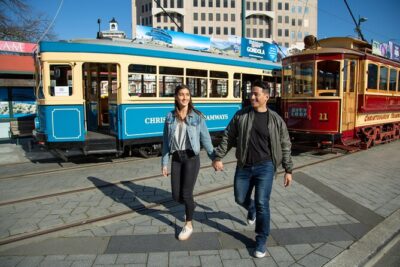
Northern Explorer Train Journey from Wellington to Auckland
Read our review →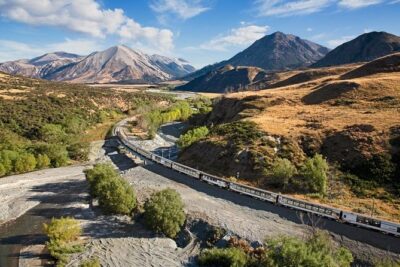
TranzAlpine Train, Arthur’s Pass and Castle Hill Day Trip
Read our review →
Coastal Pacific Train Journey from Picton to Christchurch
Read our review →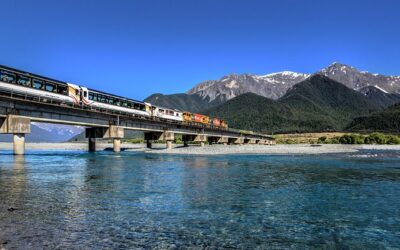
TranzAlpine Train Journey: Christchurch to Greymouth
Read our review →Browse the lists this tour appears in