
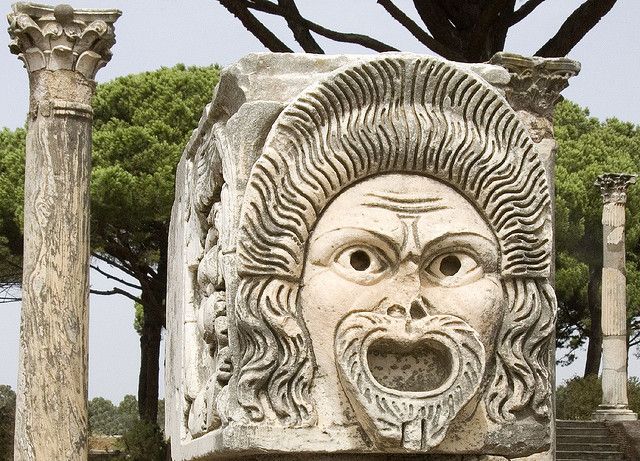
REVIEW · ROME
From Rome: Ostia Antica Guided Half-Day Trip by Train
Ostia Antica gives you something the Colosseum cannot: a chance to walk through an entire Roman town. Here, the streets lead past taverns, warehouses, public toilets, baths, theaters, and apartment blocks, making ancient daily life easier to picture. The Baths of Neptune and their sea-god mosaic are memorable highlights.
I like the short, simple train ride from Rome, and I like the small group size, limited to 12 people. Guides such as Rob, Alberto, Cat, and Laura are repeatedly praised for lively storytelling, clear explanations, and good pacing. The main drawback is the amount of walking on uneven ground, often under the sun, and the tour is not suitable for wheelchair users.
Key points at a glance
- A full Roman port town: Explore the former harbor that helped feed and supply Rome.
- Excellent everyday details: See communal toilets, bakeries, baths, shops, warehouses, and theaters.
- A short train trip: The ride from Piramide takes about 15 minutes, making this one of Rome’s easiest ancient-site outings.
- Small-group guiding: Groups are limited to 12, so you can hear the guide and ask questions.
- Time to continue alone: After the guided visit, you can see more of the archaeological park, visit the museum, or head toward modern Ostia and the beach.
- Strong guide element: The site is large and its ruins are easier to understand with a guide who can explain what each building once did.
Why Ostia Antica may be Rome’s best half-day escape
Ostia Antica was founded in the fourth century BC as Rome’s harbor town. Its position near the mouth of the Tiber made it vital to the capital’s trade, food supply, military activity, and movement of people.
The port itself changed over time, and the coastline is no longer where it was in antiquity. What remains is more useful to you than a single grand monument: an extensive town plan where ordinary Romans lived and worked.
I find this the great strength of Ostia. At Rome’s famous monuments, you admire power. At Ostia, you see plumbing, shop counters, public seating, storage rooms, apartment buildings, and places to eat. The site helps you understand how the Roman world functioned between the marble temples and imperial ceremonies.
The ruins are also far quieter than Pompeii and generally less crowded than Rome’s central sights. That matters. You can stop in the middle of an ancient street, look at a mosaic, and listen without the constant pressure of a large crowd moving behind you.
More Half-Day Trips in Rome:
- Half-Day Railway Market and Floating Market Tour in Thailand
★ 4.5 · 3,924 reviews - Dachau Small-Group Half-Day Tour from Munich By Train
★ 5.0 · 811 reviews - Hanoi City Half-Day Private Tour: Train Street And All Highlights
★ 5.0 · 298 reviews
Meeting at Piramide and taking the train
The tour begins at Cafe Piramide, at Piazzale Ostiense 9. When you face the Piramide Metro stop on Line B, the cafe is on your right, near the train tracks and the station exit. White umbrellas outside help identify it, and the guide carries a City Wonders sign.
Give yourself enough time to locate the cafe. The meeting point can be confusing if you come out of the station and focus only on the larger umbrellas across the street. The practical clue is that the cafe is close to the station and train tracks, not across the road.
Your guide provides the return train ticket and accompanies the group on the outward journey. The train ride takes about 15 minutes. This is a real advantage over a long coach transfer or an expensive private car, especially if you are staying near a Metro Line B stop.
The tour service ends back at Piramide at about 1:00 PM if you return with the group. The return ride is unescorted, though the guide explains how to use the ticket and get back. If you prefer to stay in Ostia, you can do that instead.
Entering a town built for work, trade, and ordinary life
The archaeological area is large, so a guide earns the fee quickly. Without context, you may see low walls and worn stones. With clear explanations, those same walls become a shop, a warehouse, a lodging house, or the ground floor of a taller building.
The walk follows the Decumanus Maximus, Ostia’s main east-west street. Roman statues once lined parts of the route, and the road gives you a strong sense of the town’s scale. You are not simply looking at scattered ruins. You are following the main artery of a working city.
The guide’s focus is daily life rather than a parade of dates. You learn how commerce worked, how goods moved through the port, and how people used public facilities. The best guides also use photographs, gestures, and small bits of performance to help you picture the missing upper floors and the people who used these spaces.
Several guides have drawn especially warm praise for this approach. Rob is known for acting out parts of the story and adding funny anecdotes. Alberto is often praised for keeping the group moving while stopping at the important sites. Cat and Caterina are noted for clear explanations, friendly energy, and a good sense of timing. Laura is particularly good with mixed groups that include adults and children.
Guide assignments can change, so do not book on the assumption that you will get one particular person. The useful point is that the experience depends heavily on the guide’s ability to read the site and make its fragments understandable.
The Baths of Neptune and Ostia’s best mosaic
The Baths of Neptune are one of the tour’s visual highlights. Their large mosaic shows Neptune, the sea god, being drawn in a four-horse chariot. The image fits the setting perfectly: this was a port city shaped by the sea, ships, trade, and Roman control of the coast.
Thermal baths were not just places to wash. They were social centers where people could meet, exercise, relax, and discuss business. The remains let you see how Roman public life extended beyond temples and political buildings.
The mosaic is especially valuable because it survives in place rather than appearing only as an isolated museum object. You see the artwork in the setting it was made to decorate. That connection between art and architecture is one reason Ostia can feel more personal than Rome’s grander monuments.
Bring comfortable shoes. The route covers a large area, and the ground can be uneven. In warm weather, shade is limited in parts of the site. A good guide will look for shaded stops when possible, but you should still carry water and use sun protection.
More Day Tours in Rome:
- Ancient Ostia Antica Semi-Private Day Trip from Rome by Train with Guide
★ 4.5 · 579 reviews - Venice Day Trip from Rome by High-Speed Train with Happy Hour
★ 4.5 · 445 reviews - From Rome: Day Trip to Venice by High-Speed Train
★ 4.6 · 352 reviews - Rome to Florence: High-Speed Train Day Trip with Guided City Tour
★ 4.0 · 235 reviews
The amphitheater and the communal Forica
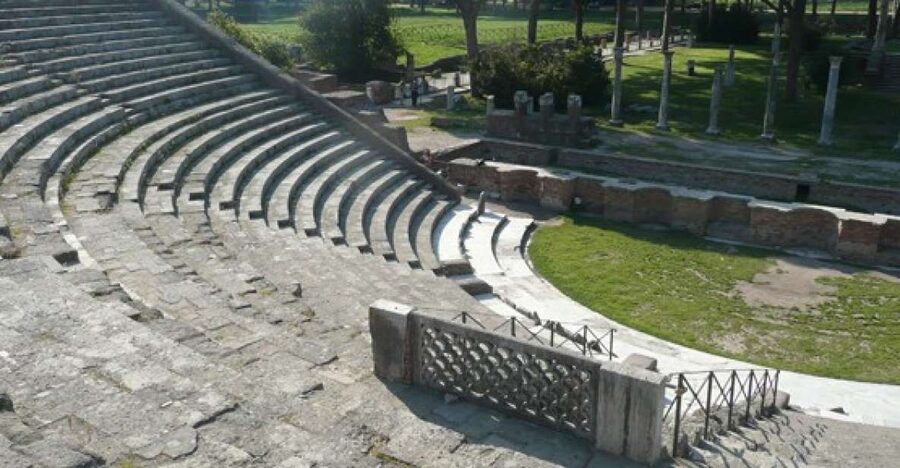
Ostia’s amphitheater gives you a chance to sit where about 3,500 spectators once watched performances. It was first built in 12 BC, and its surviving shape makes the building easy to read.
Take a moment to look across the seating area before rushing on. The theater is not the biggest ancient arena you will see in Italy, but its size makes it easier to imagine as a neighborhood venue. This is where local people gathered, rather than a distant imperial spectacle seen only through history books.
The communal Forica offers a more blunt look at Roman life. A marble bench runs around four walls, with 20 evenly spaced openings in the stone. It is an amusing stop, but it also shows how public sanitation worked in a dense city.
This kind of detail is exactly why a guided visit helps. A bare room with holes in a bench is easy to overlook. Once you understand its purpose, it becomes one of the most memorable places on the route.
There is a toilet break during the tour, along with time for a snack or drink at the snack bar. Use that pause wisely. The site is exposed, and the walking can feel tiring if you wait until the end for water or food.
Three hours on foot, with room to look around
The guided portion lasts about three hours. That is enough time to cover key streets, monuments, public buildings, and mosaics without trying to see every corner of the archaeological park.
The pace is generally active but not frantic. Guides have been praised for keeping groups moving while allowing time for questions and short periods of independent looking. A small group makes a noticeable difference here. With no more than 12 people, it is easier to hear explanations and remain together on the broad ancient streets.
Still, three hours is not enough to see everything. Ostia Antica is extensive, and you may finish the guided route wanting more. That is not a flaw, but you should understand the format. This is a strong introduction, not an exhaustive archaeological study.
At the end of the guided walk, you may remain inside the site to explore on your own. Several useful areas are near the museum, and continuing alone lets you set your own pace. Check the museum’s opening hours, especially in winter, since it may close early. One practical approach is to ask your guide where the museum is and visit it before wandering farther.
Staying on for the museum, modern Ostia, or the beach
The tour is designed as a half-day outing, but you do not have to hurry back to Rome. You can stay at Ostia Antica and continue through the archaeological park, subject to opening hours and your energy.
You can also explore the modern town of Ostia or go to the beach. The supplied packing advice includes a towel, beachwear, and sports shoes, so adding the coast is a realistic option rather than an afterthought.
If you choose to stay, plan the return on your own. Your train ticket is provided, but the guide does not accompany the group back to Rome after the official tour ends. The guide can explain the route, and the return journey is straightforward, but you remain responsible for timing.
This flexible ending is one of the tour’s best features. History fans can keep walking through the ruins. Families may prefer lunch and the beach. You can also return to Rome for an afternoon museum or a slower meal near your accommodation.
Is $58 a fair price?
At $58 per person, the tour includes the return train ticket, entry to Ostia Antica, and an English-speaking guide. You are paying less for transport than you would on a private excursion, while avoiding the uncertainty of handling the site alone.
The admission ticket and train fare are useful, but the guide is the main value. Ostia’s size and partially preserved buildings can be hard to interpret without help. A good explanation turns a row of walls into a place where people worked, washed, stored grain, watched performances, or used the public toilets.
You can visit archaeological sites independently for less if you arrange transport and tickets yourself. The tradeoff is preparation and lost context. For a first visit, especially if you have only half a day, $58 is reasonable.
The price is less attractive if you want a quiet, self-directed day and already know Roman architecture well. In that case, an independent visit may give you more freedom. For most first-time visitors, though, the guide saves time and helps you notice the details that make Ostia special.
Who will enjoy this trip most?
I would choose this tour if you have already seen Rome’s central monuments and want a different view of the ancient city. It is also a strong choice if Pompeii is not on your itinerary or if you prefer a quieter site close to Rome.
History fans will get the most from the town plan, mosaics, baths, trade buildings, and public facilities. Families can enjoy the practical details, especially the amphitheater and Forica, though children need to manage several hours of outdoor walking.
This is not the best choice for anyone who has difficulty walking on uneven surfaces, uses a wheelchair, or dislikes open-air sites in hot weather. Baby strollers are not allowed. Wear supportive shoes, bring water, and consider a hat.
The tour is offered in English. If you need another language, this is not the right fit.
Practical details that make the day easier
Book with enough time to reach Cafe Piramide, particularly if you are coming from Termini or another busy part of Rome. The Metro is useful, but station crowds can slow you down.
Wear shoes made for walking rather than stylish sandals. Pack water, sun protection, and a small snack. If you may continue to the beach, bring the towel and beachwear listed for the activity.
The tour has free cancellation up to 24 hours before departure, and you can reserve now and pay later. If a public transport strike or another unexpected transit problem affects the railway, a minibus is provided at no extra cost.
The site is not wheelchair accessible for this tour. That is an important limitation, not a minor footnote.
Should you book Ostia Antica by train?
Book it if you want Roman history at street level, a short trip from the city center, and a guide who can turn foundations and mosaics into a believable town. The strongest part is not one famous monument. It is the combined picture of work, trade, bathing, entertainment, and sanitation.
Skip it if you want a short sightseeing stop with little walking, or if you prefer to explore without a guide. Otherwise, this is a smart half-day addition to Rome. Stay afterward if you can. The ruins deserve more than a quick guided circuit, and the option of continuing to modern Ostia or the beach gives the outing unusual flexibility.
FAQ
How long does the Ostia Antica tour last?
The activity lasts about four hours, including the train journey and the guided visit. The guided portion at Ostia Antica lasts about three hours.
Where does the tour meet in Rome?
Meet at Cafe Piramide at Piazzale Ostiense 9. When facing the Piramide Metro stop on Line B, the cafe is on your right, near the train tracks and station exit. Look for the white umbrellas and the City Wonders sign.
How long is the train ride to Ostia Antica?
The outward train journey takes about 15 minutes. The return journey is listed as about 20 minutes.
Is the return train ride guided?
The guide accompanies the group to Ostia Antica, but the return journey is unescorted if you return after the tour. The guide provides the train ticket and explains how to return to Piramide.
What does the tour price include?
The $58 price includes the return train ticket from Rome to Ostia Antica, entry to the archaeological site, and an English-speaking guide.
Can I stay at Ostia Antica after the guided tour?
Yes. You can remain at the archaeological site to explore independently, visit the museum if it is open, explore modern Ostia, or continue toward the beach.
Is the tour suitable for wheelchair users?
No. The activity is not suitable for wheelchair users, and baby strollers are not allowed.
What should I bring?
Bring comfortable shoes, sports shoes, water, and clothing suitable for walking outdoors. If you plan to visit the beach afterward, bring a towel and beachwear.
Just added around Rome
- Rome: Castelli Romani Day Trip by Train and E-Bike★ 5.0 · 4 reviews
- Florence and Venice from Rome: 2-Day Semi-Private Tour by Train★ 5.0 · 2 reviews
- Villa Adriana Private Day Trip from Rome By Train★ 5.0 · 9 reviews
- Venice from Rome: Full Day Small Group Tour by Fast Train★ 4.5 · 14 reviews
- Capri Island Small Group Boat Tour from Rome by Train★ 4.5 · 69 reviews
- Venice from Rome: Private Day Trip by train with Islands Tour★ 5.0 · 25 reviews
- Florence from Rome by High Speed Train at your pace★ 4.5 · 11 reviews
- Transfer from Civitavecchia by train with Rome HopOnHopOff Option★ 3.5 · 4 reviews
Rome Train Tours, compared.
Rome to Pompeii Guided Tour with Wine & Lunch by High Speed Train
Read our review →
Ancient Ostia Antica Semi-Private Day Trip from Rome by Train with Guide
Read our review →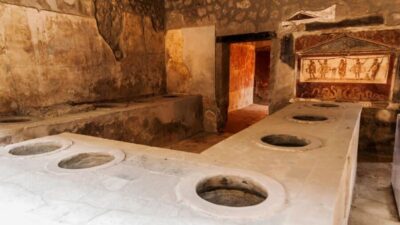
Pompeii Tour with Wine and Lunch by High Speed Train
Read our review →
Venice Day Trip from Rome by High-Speed Train with Happy Hour
Read our review →

Tuscany Comfort Day Tour from Rome with Wine & Lunch
Read our review →
Rome to Florence: High-Speed Train Day Trip with Guided City Tour
Read our review →
Pompeii and Naples Day Trip by High-Speed Train
Read our review →Browse the lists this tour appears in