
REVIEW · SOUTH KOREA
Busan city tour from Seoul by KTX bullet train
Busan is a long way from Seoul, but the KTX makes a one-day visit possible. This private tour packs the city’s seafood, beaches, hillside neighborhoods, modern sights, and coastal temple into one carefully timed day. Guides such as Jay, Min, Mira, Amy, and Solomon have been praised for adjusting the pace and helping with train seats, meals, and family photos.
I especially like the private format, which lets you ask for a slower pace, a favorite lunch, or a change in emphasis. I also like the simple train-to-tour handoff: a Seoul pickup, reserved economy-class KTX tickets, and assistance finding your seats. The catch is the clock. With roughly five hours spent on the round-trip train ride, this is a full day with little spare time.
Key points to know before booking
- KTX makes Busan possible in one day: The fast train covers the long distance between Seoul and Busan, leaving you a full sightseeing block in the middle.
- The tour is private: Only your party participates, so the guide can respond to interests, energy levels, and mobility needs.
- Busan’s contrasts come quickly: You move from Jagalchi’s seafood trade to colorful Gamcheon, Haeundae’s beach, and a temple built beside the sea.
- The day includes lesser-known history: Ami-dong’s tombstone walls and Choi Min-sik’s photography add difficult, human stories beyond standard sightseeing.
- Lunch is extra but personal: Guides have taken groups to Korean barbecue, seafood restaurants, and local spots, but food and drinks are not included.
- It is best for a first look: You see a lot, but this cannot replace several nights in Busan.
Why the KTX day trip works
The main strength here is efficiency. You leave your Seoul hotel around 7 a.m., transfer to Seoul Station, ride the KTX in reserved economy seats, and reach Busan without having to work out the rail system on your own. At the other end, a local guide meets you and handles the city portion by vehicle.
That matters because Busan’s sights are spread across a wide area. Jagalchi Market and Gamcheon Culture Village are on the western side of the city, while Haeundae, Dongbaekseom, and Haedong Yonggungsa are farther east. Public transportation can handle these places, but not easily in a single day.
The return trip is arranged in the same way. A guide helps you reach the station and locate your reserved seats. The package includes Seoul hotel pickup, but not hotel drop-off at the end, so plan for the final trip from the station yourself.
This is a private tour, not a shared bus outing. That makes a real difference. Guides have adjusted plans for families, made room for photographs, slowed the pace for older relatives, and added requested stops when time allowed. Some groups have had Jay, Min, Mira, Young, Julia, Amy, Hyounghwa, Chanwoo, Jae, Kate, or Solomon as their guide, depending on the date and arrangement.
More Bullet Train Tours in South Korea:
- Jeonju City tour by KTX bullet Train from Seoul
★ 5.0 · 2 reviews - Busan and Gyeongju 2 days Tour from Seoul by KTX Bullet Train
★ 5.0 · 2 reviews - Mt Fuji and Hakone 1-Day Bus Tour Return by Bullet Train
★ 5.0 · 26,383 reviews
Jagalchi Market and Busan’s seafood identity
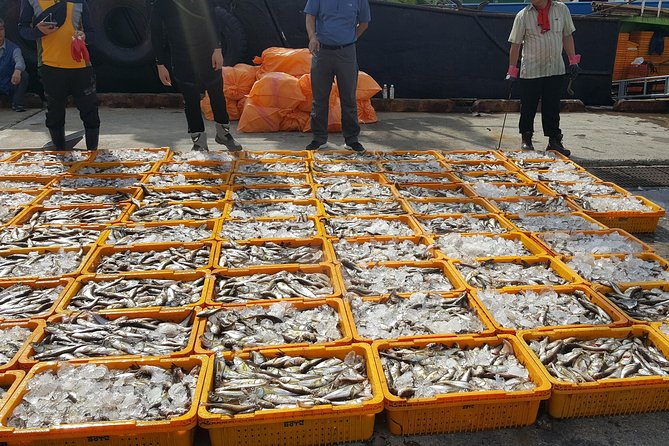
Your first major stop is Jagalchi Market, Korea’s largest seafood market. It is not simply a place to take a quick photograph. Jagalchi represents Busan’s close relationship with the sea and its role as a working port city.
The market became firmly associated with fish after the Korean War. Its story connects to Busan’s growth and to the many people who arrived in the city during and after the conflict. You get about an hour here, enough to see the market atmosphere and understand why seafood is central to local life.
Fresh raw fish can be eaten at the market, but lunch is not included in the tour price. Your guide may recommend a place or help arrange a meal, and previous outings have included seafood and Korean barbecue. Ask about the cost before ordering, particularly if you are traveling with a family or want to sample several dishes.
Jagalchi is a good early stop because it gives you a strong sense of place. The limitation is that an hour passes quickly. If you want a slow seafood meal, market shopping, and extensive photographs, you may need to choose between those activities.
Gamcheon Culture Village and the story behind the color
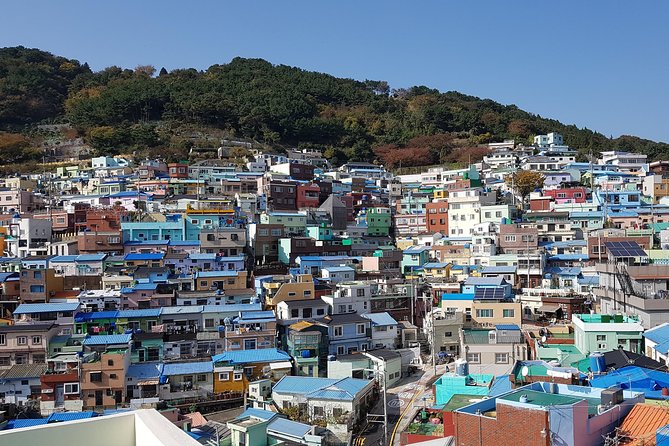
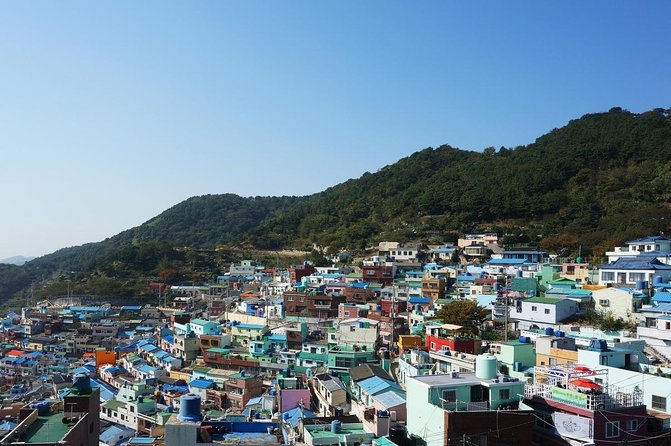
Gamcheon Culture Village is often called the Machu Picchu of Busan, a nickname based on its steep hills and layered houses rather than any direct similarity. The village began as a refuge for people fleeing to Busan during the Korean War. In 2010, a creative urban regeneration project helped reshape the area into a major cultural attraction.
You have about an hour to walk through its stairs, lanes, walls, and viewpoints. The colorful appearance is the easy part to notice. The more important point is the human story underneath it: Gamcheon grew from hardship, displacement, and limited space.
The hills make this stop physically demanding for some people. There are stairs and uneven sections, so tell your guide if you need a gentler route. The private format helps here, since your guide can adjust the pace instead of moving a fixed group onward.
Because Gamcheon receives about 1.4 million Korean and international visitors each year, it can feel busy. Even so, it is one of the strongest stops for a first visit to Busan, especially if you want photographs and a clear introduction to the city’s postwar development.
Haeundae Beach and Busan’s modern side
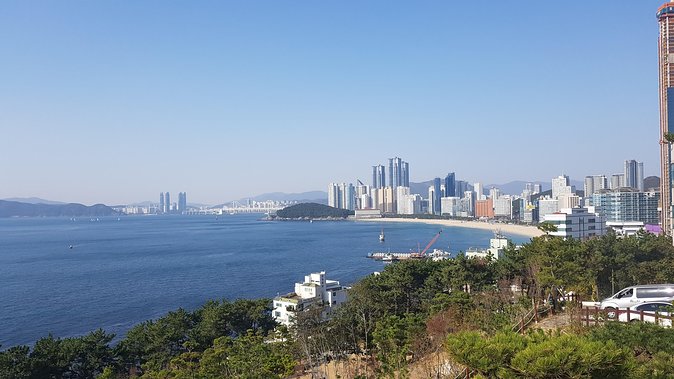
Haeundae Beach shows you a different Busan. The white sand stretches roughly 1.5 kilometers along a shallow bay, with a width of about 30 to 50 meters. It is the city’s best-known beach and a major part of its modern public image.
The tour allows about an hour here. You can walk along the shore, take photographs, and enjoy a pause after the hills of Gamcheon. This is not a swimming-focused outing, so do not expect a long beach stay or time for a full day beside the water.
Haeundae is valuable because it changes the rhythm of the tour. Jagalchi is about commerce, Gamcheon about settlement and renewal, and Haeundae about recreation and the city’s coastal appeal. You see how Busan can feel like a working port, a hillside town, and a beach resort within the same day.
If you prefer old neighborhoods and historical sites, this may be the least compelling stop. If you want to understand why Busan is also a major seaside destination, it earns its hour.
More City Tours in South Korea:
- Busan: Full-Day City Tour with Taejongdae, Gamcheon & More
★ 4.7 · 35 reviews - Busan Full-Day City Tour with Gamcheon Village, Sea Temple & more
★ 4.5 · 27 reviews - Granada City Train 1 or 2-Day Hop-On Hop-Off Ticket
★ 3.5 · 3,128 reviews - Porto: City Train Tour, River Cruise & Wine Cellar
★ 3.9 · 2,601 reviews
Haedong Yonggungsa, a temple beside the sea
Haedong Yonggungsa is one of the day’s most memorable settings. Most Korean temples are found in mountain areas, while this one sits along the northeastern coast of Busan. Its position beside the water gives it a different mood from the inland temple sites you may see elsewhere in Korea.
You get about an hour to explore. The coastal setting is the main draw, so allow time to look beyond the buildings and take in the sea views. The site also requires walking, and the approach can include steps. Comfortable shoes will make the day easier.
The temple is especially useful for people who want more than urban sightseeing. After markets, colored houses, and a famous beach, Haedong Yonggungsa adds a religious and coastal dimension. It also gives your guide a chance to explain how Korean temple locations vary.
The tradeoff is travel time. Haedong Yonggungsa is not close to the western stops, and reaching it helps explain why this tour must keep moving. You will see it, but you will not have the hours available on a dedicated temple visit.
Dongbaekseom and the APEC House
Dongbaekseom means Camellia Island, named for the camellia trees associated with Korea’s southern provinces and coastal areas. The island is now connected to the mainland, but the name remains.
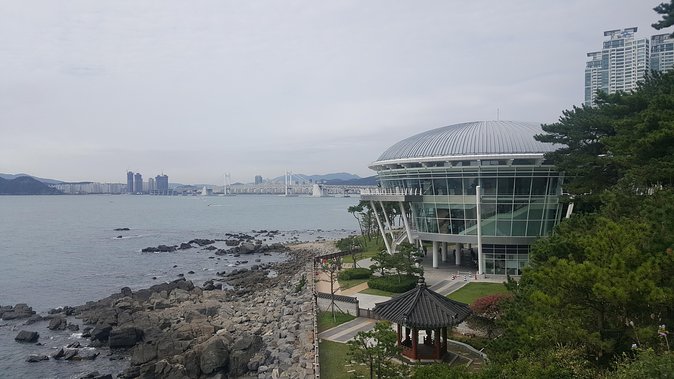
The stop includes Nurimaru APEC House, a roughly three-story building built for the final summit meeting of the Asia-Pacific Economic Cooperation conference. It adds a modern political and architectural note to a day otherwise filled with markets, villages, and religious sites.
The visit lasts about an hour. This is a useful stop for a broad first tour because it connects Busan to international business and diplomacy. You also get another coastal setting without repeating the exact feel of Haeundae.
The itinerary is packed, so your guide may manage this stop around traffic and the time available at other locations. If your main interest is historic architecture, ask how much time can realistically be spent at Nurimaru APEC House.
Choi Min-sik Gallery and Ami-dong’s difficult history
The Choi Min-sik Gallery is a short, 20-minute stop, but it carries unusual weight. Choi Min-sik was a first-generation documentary photographer who focused on ordinary people living through war, poverty, and Busan’s modernization.
His black-and-white photographs show people on Busan’s streets rather than grand monuments. The gallery gives you a human view of the city, and it helps connect the polished attractions to the lives of people who built and endured Busan’s difficult decades.
Ami-dong Tombstone Culture Village takes that history further. People began living in tents here in 1951. As the settlement became more permanent, homes were built over Japanese graves, and tombstones became part of the stairs and walls.
That fact can be startling. The village is not a decorative photo stop. It shows how desperate housing conditions shaped the city after the war and how Busan expanded up its mountains. From Ami-dong, you can see across much of the city.
You have about 40 minutes here. The stairs and steep terrain require care, but the stop is short enough to keep the day moving. It is also one of the most meaningful places on the route because it complicates the usual image of Busan as beaches and seafood.
How lunch and guide flexibility affect the day
Food and drinks are not included, but lunch can become one of the better personal moments of the outing. Guides have taken groups to seafood restaurants by the beach, Korean barbecue places, and small local restaurants they enjoy with their own families.
That flexibility is useful, but it also means the final meal depends on your guide, timing, appetite, and preferences. Tell the guide early if you want seafood, barbecue, a quick meal, or extra time at the table. A long lunch may force a shorter stop elsewhere.
The guides are consistently described as friendly, attentive, and willing to answer questions. More important than a formal speech is the practical help: escorting you to train seats, taking family photographs, adjusting hills for an older family member, and responding to specific interests. One guide even helped a group make room for a requested shopping stop and a meal at a preferred restaurant.
The private setup does not guarantee a custom itinerary with unlimited changes. There are seven listed stops, a long train journey, and a fixed return schedule. Think of it as a guided framework with room for small adjustments.
Is $415 a fair price?
At $415 per person, this is not a cheap way to see Busan. The price includes a private one-day city tour, an English-speaking guide, round-trip KTX economy fare, and pickup from your Seoul hotel. It does not include meals or the final hotel drop-off.
The value depends on what you would otherwise need to arrange. You are paying for train tickets, local transportation, coordination between Seoul and Busan, a private guide, and help at both stations. For a group that wants a smooth day without handling Korean rail connections, that can be worthwhile.
It is especially useful for families and small parties with limited Korea time. A cheaper self-guided trip is possible, but you would need to book the KTX, plan a route across a spread-out city, manage transfers, and watch the return train. The private tour removes much of that work.
I would not choose it if you have several free days in Busan. In that case, staying overnight gives you more time for meals, neighborhoods, museums, markets, and a slower coastal visit. This tour is best understood as an expensive but efficient introduction.
Who should book this Busan day trip?
I would recommend it to a first-time visitor with only one open day, a family that wants help with transport, or anyone uneasy about navigating a long Seoul to Busan journey alone. It also suits people who value context and conversation more than independent wandering.
Older family members can benefit from the private pace, though the route still includes hills, stairs, and a full day on the go. Tell the provider about mobility concerns before departure. Service animals are allowed, and most people can participate, but the physical demands should not be ignored.
I would be cautious about booking if you dislike early starts, long train rides, or tightly planned sightseeing. The advertised duration is about nine to ten hours, and the train alone takes roughly five hours round trip. This is a productive day, not a restful one.
The tour requires at least two people per booking. Confirmation is provided at booking, and free cancellation is available up to 24 hours before the start time. Changes or cancellations inside that window are not accepted, and the minimum number of participants must be met.
Should you book it?
Book this tour if you want to see Busan in one day and prefer a guide to handle the difficult parts. The best reasons are the private vehicle, the reserved KTX seats, the thoughtful station assistance, and the range of stops, from Jagalchi’s seafood trade to Ami-dong’s postwar story.
Skip it if you can stay in Busan for two or three nights. You will get better meals, less rushing, and more time in each neighborhood. But for a Seoul-based itinerary with one precious day available, this is a practical way to add Busan without losing a night in the capital.
FAQ
How long does the Busan tour from Seoul last?
The experience lasts approximately nine to ten hours. The start time is 7:00 a.m., and the day includes the round-trip KTX journey between Seoul and Busan.
Is KTX transportation included?
Yes. Round-trip KTX economy-class fare is included in the price.
Does the tour include hotel pickup and drop-off?
Hotel pickup in Seoul is included. Hotel drop-off in Seoul is not included, so you will need to arrange your own onward transfer after returning to the capital.
Is this a private tour?
Yes. Only your group participates, and a minimum of two people is required per booking.
Are meals included?
No. Food and drinks are not included. Your guide may recommend or arrange a restaurant, with past meals including seafood and Korean barbecue, but you pay separately.
Which Busan attractions are included?
The route includes Jagalchi Market, Gamcheon Culture Village, Haeundae Beach, Haedong Yonggungsa, Dongbaekseom, the Choi Min-sik Gallery, and Ami-dong Tombstone Culture Village.
Can I cancel for a full refund?
You can cancel at least 24 hours before the experience start time for a full refund. Cancellations or changes made less than 24 hours before the start time are not accepted for a refund.
Just added around South Korea
- Seoul Tram Pedal Challenge★ 5.0 · 32 reviews
- Scenic Escape: Nami Island, Garden of Morning Calm, and Rail Bike★ 3.0 · 2 reviews
- Nami Island & Petite France & Italian Village & Gangchon Rail Bike One-Day Tour★ 4.5 · 52 reviews
- Gyeongju UNESCO Sites Tour by KTX train; The Museum Without walls★ 4.5 · 11 reviews
- Private Tour Rail Bike & Nami Island & (Petite France or Garden of Morning Calm)★ 4.5 · 13 reviews
- Nami Island Trip with Petite France & Italian Village and Gangchon Rail Bike★ 4.5 · 41 reviews
- Eobi+Nami+Hanbok Tour with Rail Bike or Strawberry Option★ 5.0 · 10 reviews
- Special Private Tour Nami Island, Rail Bike, Petite France★ 5.0 · 42 reviews
South Korea Train Tours, compared.
Nami Island, K-drama Garden & Rail Bike Day Tour
Read our review →
Day Trip to Nami Island with Rail bike and The Garden of Morning Calm
Read our review →
Nami+Alpaca+Garden of Morning Calm (+Rail Bike Option)
Read our review →
Alpaca, Nami, Morning Calm or Eobi (+Rail Bike)
Read our review →
Full-Day Tour in Mt. Seorak & Nami (+Rail Bike Option)
Read our review →
Alpaca World and Nami Island with Gangchon Rail Bike Tour
Read our review →
Nami Island & Petite France & Italian Village & Gangchon Rail Bike One-Day Tour
Read our review →
Special Private Tour Nami Island, Rail Bike, Petite France
Read our review →Browse the lists this tour appears in