
REVIEW · CAIRO
Cairo: Luxor East and West Banks Guided Tour& Overnight Sitting Train Round Trip
Luxor is Egypt’s great ancient-theater day, and this tour gets you there without booking hotels, trains, and local transport on your own. You leave Cairo by first-class seated overnight train, wake in Luxor, and spend the day moving between the West Bank tombs and East Bank temples.
I like the small maximum group of 15, plus the private air-conditioned vehicle in Luxor. I also like the order of the day: Valley of the Kings and Hatshepsut first, Karnak and Luxor Temple later. The catch is simple: this is a long haul. You spend about nine hours on the train each way, and the train seats are not sleeper berths.
If Hany is your guide, expect clear explanations and a strong focus on ancient sites. Mohammed has also been praised as a careful driver. The main thing to consider is the price, $333 per person, which does not include entrance fees. Add those costs, and you are paying for convenience rather than a cheap way to see Luxor.
Key points to know before you book
- Two nine-hour train rides shape the whole trip: You save hotel costs, but the overnight seats may make sleep difficult.
- One full sightseeing day covers both banks of Luxor: You see the major highlights, but the schedule is packed.
- The West Bank comes first: The Valley of the Kings, Hatshepsut Temple, and Colossi of Memnon are visited before the East Bank temples.
- A guide and air-conditioned vehicle are included in Luxor: This makes the hot, spread-out sites much easier to manage.
- Entrance fees are extra and payable in Egyptian pounds: Bring an international student card if you have one, since it gives a 50 percent discount on entrance fees.
- The group is capped at 15 people: That is small enough for questions without promising a fully private tour.
Leaving Cairo for a seated overnight train
Your tour begins with pickup at your hotel in Cairo or Giza. From there, you are taken to the train station for the first-class VIP seated train to Luxor.
The train ride takes about nine hours. That sounds manageable on paper, but the timing matters. You are not heading to a sleeper cabin unless you pay an additional $150 per person for a round-trip upgrade. The standard arrangement is a seated overnight trip, so you should bring whatever helps you rest comfortably and keep your expectations realistic.
The first-class label means this is the better seated option offered for the tour, not a private sleeping compartment. If you sleep well in a reclining seat, this can be a practical way to cover the long distance. If you need a proper bed, the sleeper upgrade may be worth considering.
There is also a chance the sitting train will be changed to a VIP bus at no extra cost. That may suit you if the train schedule changes, but it also means the exact transport experience is not completely fixed. Ask about the arrangement before departure if the train itself is an important part of your plan.
The best part of this overnight format is efficiency. You do not lose a separate day to travel down to Luxor, and you do not need to arrange a Cairo hotel for the night between the two sightseeing days. The tradeoff is fatigue. You arrive in the morning and begin touring soon after, then repeat the long ride back to Cairo that night.
More Guided Trips in Cairo:
Morning at the Valley of the Kings
You arrive at Luxor in the morning and meet your licensed guide at the train station. A private air-conditioned vehicle then takes you to the West Bank, beginning with the Valley of the Kings.
This is the stop that gives Luxor its instant drama. The tombs are cut into the dry hills, away from the broad river and cultivated land. You visit the burial area associated with rulers including Thutmose I, Thutmose III, Tutankhamun, Ramesses VI, Merenptah, and Amenhotep II.
Your entrance ticket is not included, and the tour information says entrance fees should be paid on site in Egyptian pounds. That detail is easy to miss when comparing prices. The number of tombs open can vary, and your guide will help explain which ones are included under the admission arrangement, but the supplied details do not promise specific tomb interiors beyond the site visit.
Allow about two hours here. The Valley of the Kings is not a quick photo stop. You need time for the approach, the explanation, and the tombs themselves. Some passages and chambers can be close or demanding for anyone who dislikes confined spaces, though the tour data does not give a formal accessibility rating.
The guide matters most at this stop. Without context, a tomb can look like a series of painted walls. With a good explanation, the colors, symbols, and burial purpose begin to make sense. Hany has been singled out for especially clear and complete explanations, so if he is leading your group, take advantage of the chance to ask questions.
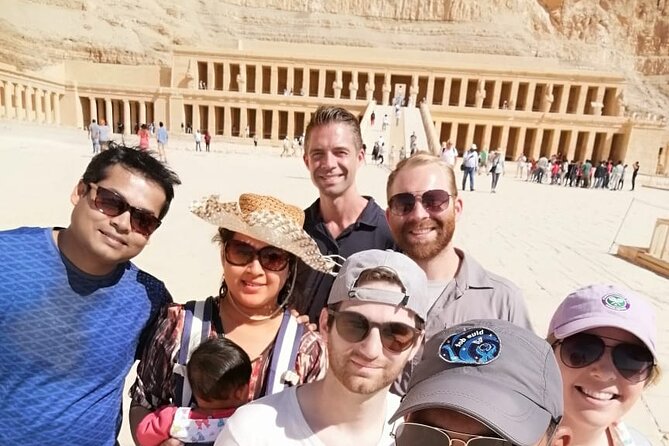
Hatshepsut’s temple at Deir el Bahari
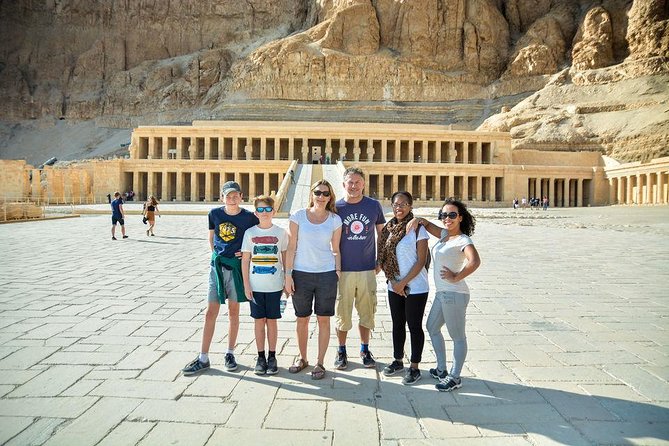
Next comes the Temple of Queen Hatshepsut, with about an hour and a half at the site.
The temple rises in terraces against the cliffs of Deir el Bahari. Its setting is very different from the underground tombs. Here, the scale and alignment of the architecture do much of the talking, while the guide fills in the story of Hatshepsut, the only female ruler highlighted in this tour.
This is a useful pairing with the Valley of the Kings. The first stop takes you below ground into royal burial places. The second shows a formal temple built for religious ceremonies and royal memory. You see two sides of ancient Egyptian rule in the same morning.
Again, admission is extra. The air-conditioned vehicle is particularly useful on this part of the route, since the West Bank sites are spread out and the sun can be strong. Bring your camera, as requested, but also remember that photography rules can differ by site and may not be covered in the booking details.
The schedule gives you enough time to understand the place, but not enough for a slow, independent wander. If you prefer to linger at one monument for half a day, this tour will feel brisk. If your goal is to see the main sites in one concentrated outing, the timing works well.
A short look at the Colossi of Memnon
The Colossi of Memnon receive about 40 minutes. These huge stone figures once guarded the entrance to the mortuary temple of Amenhotep III.
This is the shortest sightseeing stop, and that makes sense. The statues are easy to view from the open area, so you can get a close look and hear the story without spending hours there. The stop also gives you a brief pause between the larger West Bank monuments and the East Bank temples.
The tour describes the colossi as part of Amenhotep III’s mortuary temple. Much of that temple no longer survives, which is exactly why the guide’s explanation helps. You are looking at two surviving pieces of a much larger royal complex.
Admission is listed as free. Use the time for photographs, but do not expect a full site visit on the scale of the Valley of the Kings or Karnak.
More Train Tours in Cairo:
- Egypt on Budget – 8 Days ( Cairo , Aswan , Nile Cruise – Luxor ) Sleeper Train
★ 4.5 · 121 reviews - Overnight Luxor Tours by train from Cairo with Hot Air Balloon and much more
★ 5.0 · 29 reviews - 6- Days Aswan , Abu Simbel , Cruise , Luxor & Round Sleeper Train
★ 5.0 · 25 reviews - Cairo : Luxor East and West Banks Tour & Overnight SLEEPER Train Rounded trip
★ 4.5 · 21 reviews
Karnak Temple and its giant Hypostyle Hall
After crossing to the East Bank, you visit Karnak Temple for about two hours. This is the largest and most demanding stop of the afternoon.
Karnak was dedicated first to Amon Ra, his wife Mut, and their son Khonsu, with later rulers adding their own buildings and monuments. The complex covers a huge area and contains more than 20 temples. You will not see every corner in two hours, but you will get the major architectural experience.
The Hypostyle Hall is the main event for many people. Its forest of giant columns gives you a sense of the scale ancient builders aimed for. The columns are shaped like papyrus plants, and the space is one of the finest examples of ancient Egyptian design included on this route.
Karnak rewards a guide who can impose order on a very large site. It is easy to wander among columns and lose track of what you are seeing. Your guide can point out the main religious spaces, explain how later kings added to the complex, and help you understand why the site grew into such a vast center of worship.
Two hours is enough for a strong first look. It is not enough to inspect every relief or courtyard. If you are passionate about ancient architecture, you may wish you had more time. For a first visit from Cairo, the focused route is a fair compromise.
Entrance is not included here either. Keep Egyptian pounds available and use your international student card if eligible. The student card is said to provide a 50 percent discount on entrance fees in Egypt, which can reduce the extra cost of a full day of sites.
Luxor Temple at the end of the day
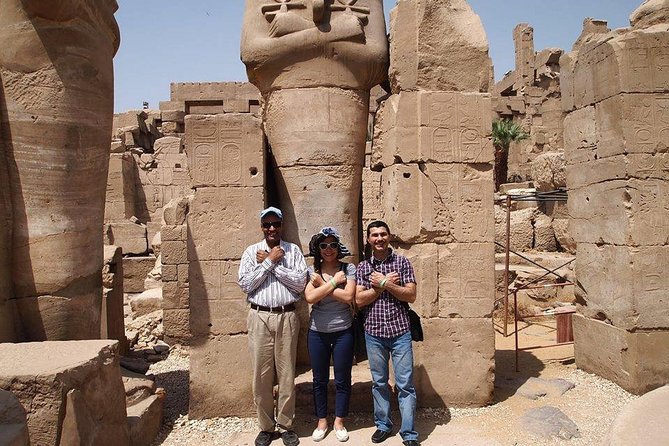
The final major stop is Luxor Temple, with about an hour and a half.
This is a fitting finish because the temple offers a different feel from Karnak. You arrive after seeing a huge religious complex, then focus on another major temple in the heart of Luxor. The timing also lets you end the sightseeing portion with one of the city’s defining monuments rather than rushing straight back to the station.
Your guide will explain the temple’s religious and royal role, while you take in the columns, courts, and ceremonial spaces. The tour information does not promise a special evening lighting visit, so do not book this assuming a dedicated night tour. The exact feel of the stop depends on the day’s pace and train schedule.
By this point, the long day may catch up with you. That is the central weakness of the itinerary. You visit five major monuments after an overnight train ride, then board another overnight train. The reward is a remarkable amount of Luxor in a short period. The cost is tired legs and limited time for pauses.
The return train and Cairo arrival
After Luxor Temple, you are taken to the station for the overnight seated train back to Cairo. The return ride also takes about nine hours.
The tour includes station transfers in Cairo and Luxor, as well as transfers and touring in air-conditioned vehicles. One important detail needs careful attention: pickup at the Cairo station after you return around 5 AM is not included as standard. It can be requested for an extra cost.
That means you should not assume the final hotel drop-off is part of the base arrangement. The tour does include pickup at the start from your Cairo or Giza hotel, but the early-morning return pickup needs separate confirmation. At 5 AM, arranging this in advance is sensible.
The overall duration is described as about three days, but the structure is better understood as one travel night, one full Luxor sightseeing day, and a second travel night ending early the next morning. You get a lot of ancient Egypt, but very little downtime.
Is $333 a fair price?
At $333 per person, the price is not the cheapest way to reach Luxor. It includes first-class seated train tickets in both directions, hotel pickup at the beginning, station transfers, the Luxor vehicle, a guide, service charges, taxes, landing fees, and parking fees.
That bundle has real value if you do not want to manage Egyptian rail tickets, local transport, and a West Bank to East Bank route yourself. Luxor’s monuments are spread out, and private air-conditioned transport makes the day easier, especially in hot weather.
Still, the entrance fees are extra. You also need to budget for food and any personal purchases, since those are not listed among the inclusions. The actual cost will therefore be higher than $333.
I would call this a convenience-focused price. It suits you if time in Cairo is limited and you want the main Luxor sights arranged in one package. It suits you less if you want a relaxed Luxor stay, a private guide, or a proper sleeper train without paying the extra upgrade.
The maximum group size of 15 keeps it from feeling like a giant coach outing. It does not guarantee a private experience, but it should give you a reasonable chance to hear the guide and ask questions.
Who will get the most from this tour?
This tour is best for a first visit to Egypt when you want Luxor’s essential monuments without arranging the details yourself. It is also useful if you have only three days and do not want to spend time comparing trains, drivers, and local guides.
You should be comfortable with a demanding schedule. The seated overnight train can be the deciding factor. If you need reliable sleep, consider the $150 round-trip sleeper upgrade before booking.
The experience also works well for history-minded visitors who want explanations at the monuments rather than a simple transfer between sites. Hany has been praised for being especially clear and historically informed, and Mohammed has been praised as a helpful driver. You cannot assume they will always be assigned, but their names are worth asking about when confirming your booking.
Families can participate, although children must be accompanied by an adult. Most people can take part, but the information does not promise special accessibility arrangements, so ask directly if you have mobility concerns.
Free cancellation is available when you cancel at least 24 hours before the start time. Inside that window, the payment is not refunded, and changes are not accepted.
Should you book it?
Book this tour if you value simplicity and coverage more than comfort and free time. You will see the Valley of the Kings, Hatshepsut Temple, Colossi of Memnon, Karnak, and Luxor Temple in one tightly arranged day, with transport and a guide already in place.
Skip it if a seated overnight train sounds miserable, or if you want to spend several calm days studying Luxor. Before paying, confirm three things: the entrance-fee budget in Egyptian pounds, the exact return pickup plan at Cairo station, and whether the standard train or sleeper upgrade suits you.
For a short Egypt trip, the tour is a practical way to connect Cairo with Luxor. Just treat the schedule honestly: it is an efficient sightseeing mission, not a restful holiday.
FAQ
How long does the tour take?
The experience lasts about three days. You travel overnight from Cairo to Luxor, spend a full sightseeing day there, then take an overnight train back to Cairo and arrive around 5 AM.
Is hotel pickup included?
Pickup is included from hotels in Cairo or Giza at the start of the tour. Pickup from Cairo train station after returning is not included as standard, but it can be requested for an additional cost.
What kind of train is included?
The standard package includes first-class VIP seated train tickets for the Cairo to Luxor and Luxor to Cairo journeys.
Can I upgrade to a sleeper train?
Yes. A sleeper-train upgrade is available for an additional $150 per person for the round trip.
Are entrance fees included?
No. Entrance fees for the sightseeing sites are not included and should be paid on site in Egyptian pounds.
Can an international student card reduce the admission cost?
Yes. The tour information states that an international student card provides a 50 percent discount on entrance fees in Egypt.
What sites are visited in Luxor?
The route includes the Valley of the Kings, Temple of Hatshepsut at Deir el Bahari, Colossi of Memnon, Karnak Temple, and Luxor Temple.
How large is the group?
The activity has a maximum of 15 people. A guide and air-conditioned vehicle are included for the Luxor touring day.
Just added around Cairo
- over night by train from Cairo to luxor with hot air balloon★ 5.0 · 2 reviews
- 2-Day Private Tours to Luxor and Dendera from Cairo by Sleeper Train★ 5.0 · 3 reviews
- Private Tour: 8 Days 7 Nights Great Pyramids & Nile Cruise by Train from Cairo★ 4.5 · 3 reviews
- Luxor Day Tour by Sleeper Train★ 5.0 · 3 reviews
- Package 8 Days 7 Nights to Pyramids, Luxor & Aswan by Train★ 5.0 · 3 reviews
- Cheap Egypt holiday 11 Days Cairo-Luxor-Aswan-Abu Simbel by sleeping train★ 5.0 · 4 reviews
- 10 Day Around Egypt to Cairo ,Giza ,White desert ,Nile Cruise With Train & Hotel★ 5.0 · 5 reviews
- Package 7-Days 6-Nights Cairo Pyramids, Nile Cruise&Alexandria by Sleeper Train★ 5.0 · 2 reviews
Cairo Train Tours, compared.

Overnight Luxor Tours by train from Cairo with Hot Air Balloon and much more
Read our review →
6- Days Aswan , Abu Simbel , Cruise , Luxor & Round Sleeper Train
Read our review →
Luxor East and West Banks Tour & Overnight SLEEPER Train Rounded trip
Read our review →
Luxor East and West Banks Tour by Overnight Sitting Train Rounded trip
Read our review →
4 Days Nile cruise luxor, Aswan,Hot air balloon&abu simbel with Train from Cairo
Read our review →
12-Night Private Tour: Amarna and El Minya with Cruise and Train
Read our review →
Egypt 8 D: Cairo, Aswan,Abu Simbel, cruise, Luxor & Sleeper Train
Read our review →
Kings of Ancient Egypt : 6 Days Cairo and Luxor Guided Tours & Overnight Train
Read our review →Browse the lists this tour appears in