
REVIEW · MUMBAI
Mumbai: Dharavi Slum and Dhobi Ghat Tour with Train Ride
Mumbai’s most revealing sights are often found away from the grand monuments. This three-hour tour links Dhobi Ghat, where laundry workers scrub and dry clothing in an enormous open-air complex, with a Mumbai local train ride and a walking tour through Dharavi. It gives you a close look at how work and community shape the city.
I like the train ride because it is not a staged attraction. You join the same transport system used by Mumbai residents each day. I also like the small group, limited to 10 people, and the chance to walk Dharavi with guides such as Bhaarti and Abhishek, who have personal ties to the community. The main drawback is that Dharavi can feel confronting, and a three-hour tour moves quickly.
Key points to know before booking
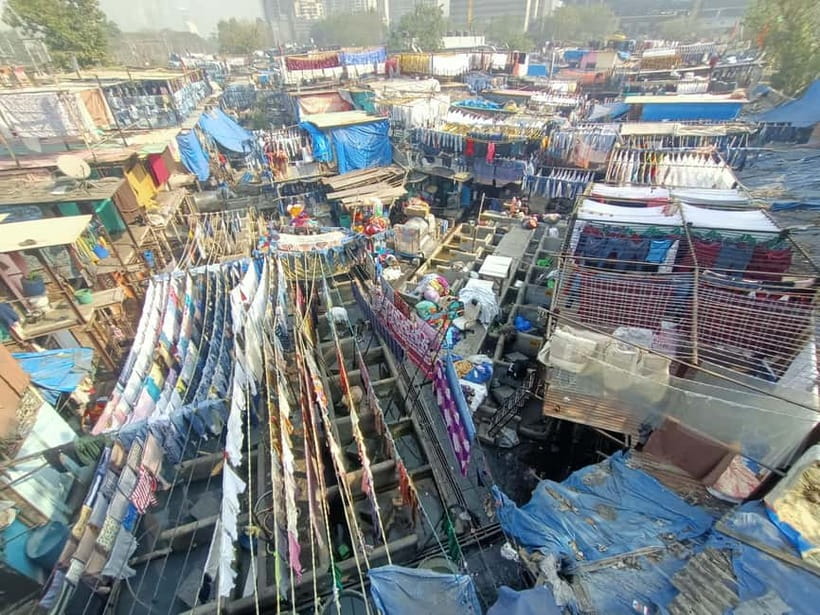
- Dhobi Ghat from the viewing deck: Look down on rows of washing pens and workers handling the city’s laundry.
- A real Mumbai train ride: Train tickets are included, giving you a short taste of one of India’s busiest urban transport systems.
- Dharavi beyond the label: Walk through working lanes and see the industries and homes that make up daily life.
- Local guides with personal ties: Bhaarti and Abhishek have been praised for their direct knowledge of the area and its people.
- Small-group format: With no more than 10 participants, you can ask questions without shouting across a crowd.
- Simple logistics: Meet at Third Wave Coffee and finish at the Dhobi Ghat Viewing Deck, with bottled water included.
Why this Mumbai tour is different
Many Mumbai tours stay on the surface: grand buildings, seaside views, and a quick photograph at a famous landmark. This one focuses on the city as a place of work. You see laundry being processed, commuters packed into trains, and small businesses operating within Dharavi’s close-set lanes.
That makes the tour useful if you want context rather than a checklist of sights. Dharavi is often reduced to a single label, but the walk presents it as a working community with homes, businesses, and people earning a living. The guide’s role matters greatly here. The strongest reports come from guides with local connections, including Bhaarti, who grew up in the area, and Abhishek, who lives there.
You should also know what this tour is not. It is not a quiet architectural walk or a polished cultural show. You may find the streets narrow, crowded, and visually intense. The subject matter can raise uncomfortable questions about poverty, housing, labor, and opportunity. A good guide helps you see people as neighbors and workers, not as scenery.
More Train Tours in Mumbai:
- Dabbawala, Dhobi Ghat & Dharavi slum Tour with Local Train Ride
★ 5.0 · 102 reviews - Primmum Mumbai Sightseeing With Local Train Ride Experience
★ 5.0 · 7 reviews - Mumbai City + Dabbawala aka Lunchbox + Train Ride Tour – The Unfeigned Mumbai.
★ 5.0 · 6 reviews
Dhobi Ghat: Mumbai’s laundry at ground level
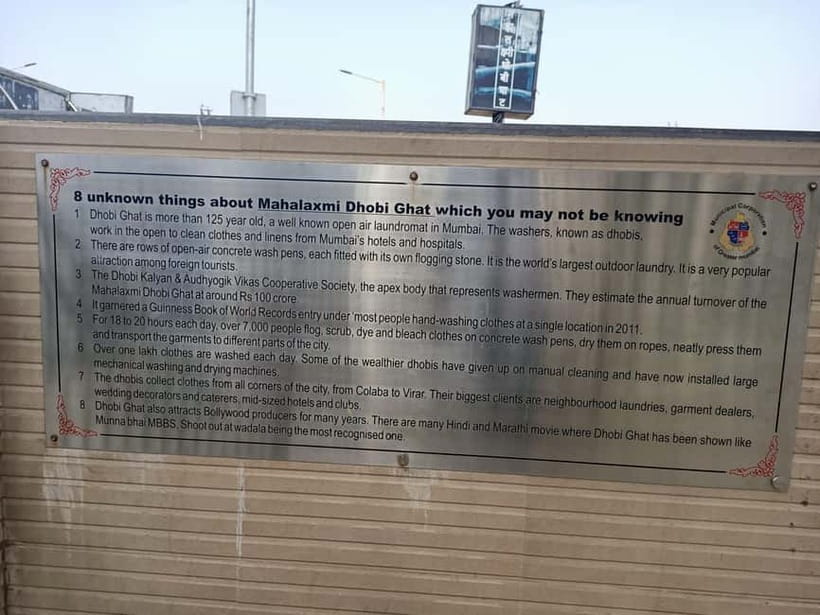
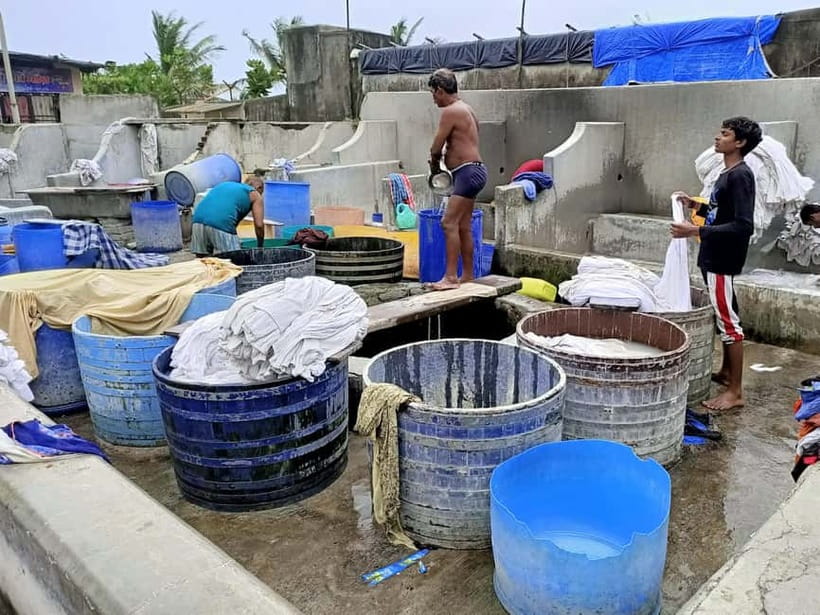
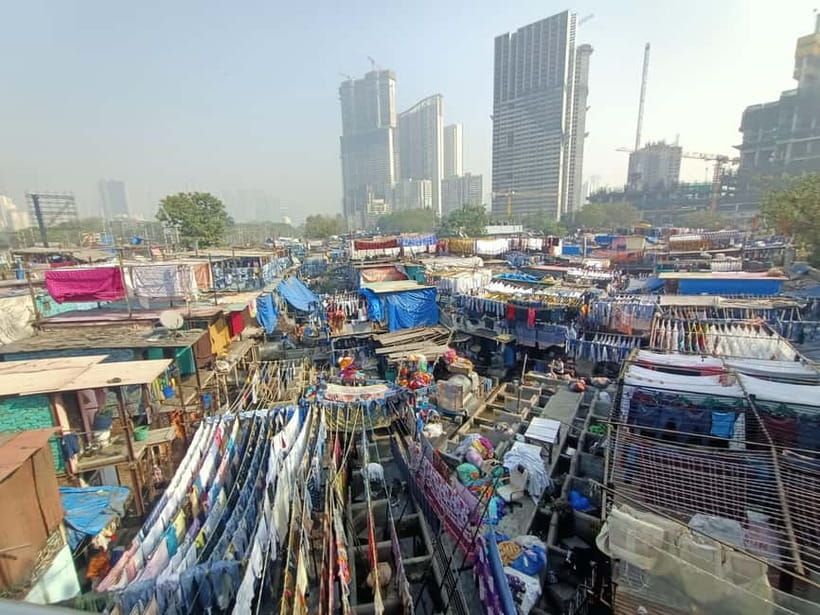
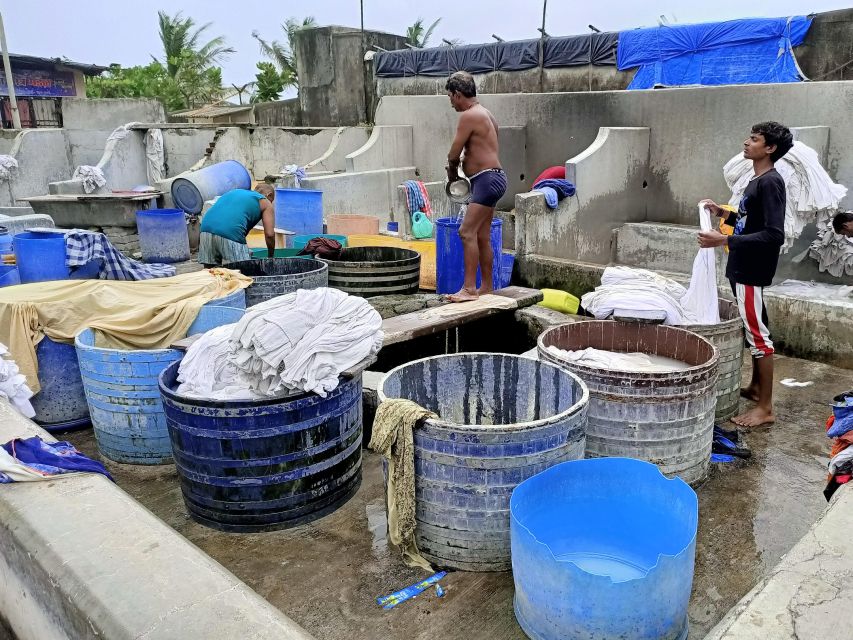
Dhobi Ghat is the first major sight on the route, and it is one of Mumbai’s most memorable urban scenes. From the viewing platform, you look down into a large open-air laundry where clothes are washed, beaten, rinsed, and hung out to dry.
The scale is the first surprise. This is not a few workers washing shirts by hand. It is a long-running work center tied to the city’s daily needs. Rows of washing spaces create a striking pattern from above, while the guide explains how the laundry operates and why it matters to Mumbai.
The viewing deck also gives you one of the clearest photographs of the site. Still, the photo is only the starting point. I would pay attention to the work itself: the repetitive motion, the sorting of garments, and the practical use of every available space. The scene is impressive because it is functional, not arranged for visitors.
The tour information describes Dhobi Ghat as a 30-minute visit. That is enough for a view, an explanation, and photographs, but not a long study of the site. Some reports describe getting closer to the laundry area, so the exact access may depend on the day and the guide. Do not assume you will have unlimited time inside the working spaces.
If you have strong expectations about entering the laundry, ask the guide at the start. The viewing deck is clearly part of the route, while access beyond it may vary. Either way, this stop gives you a useful introduction to Mumbai’s working neighborhoods before you reach Dharavi.
The local train: a short ride with a big payoff
The train segment is the bridge between the two main visits. You receive a train ticket, and the ride gives you a brief taste of Mumbai’s famous commuter system.
This is one of the best reasons to choose this particular tour. A train ride on your own can be confusing if you do not know the stations, ticket process, or route. Here, the guide handles the basic structure while you watch the city move around you.
The ride is likely to feel energetic. The open doorways and the rush of air create the memorable sensation described by past participants. That is also the point where you should use common sense. Hold your belongings securely, listen to the guide, and follow instructions when boarding and leaving the train.
The supplied schedule contains an obvious timing error, listing the train portion as 10 hours even though the full tour lasts three hours. Read this as a short transfer, not an all-day rail journey. The actual duration can depend on the route and city conditions, so do not book another tightly timed activity immediately afterward.
This is public transport, not a private scenic ride. You will not get a narrated tour of every building outside the window. The value is the ordinary experience: the sound of the train, the crowded carriage, and the sense of how Mumbai commuters move between work and home.
Walking through Dharavi’s working lanes
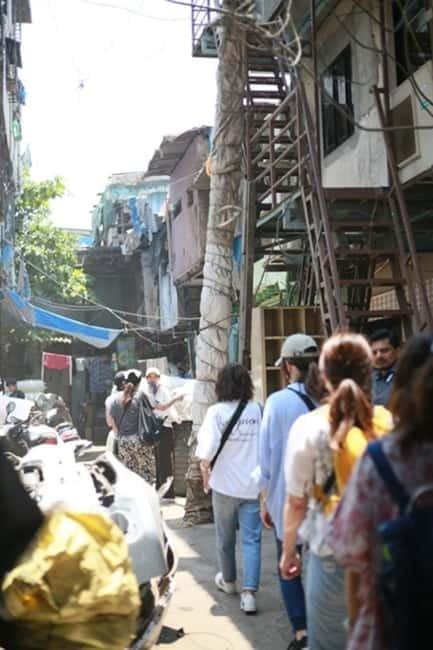
The Dharavi portion is the heart of the tour and lasts about two hours. Your guide leads you on foot through the lanes, explains local businesses, and discusses the community’s working life.
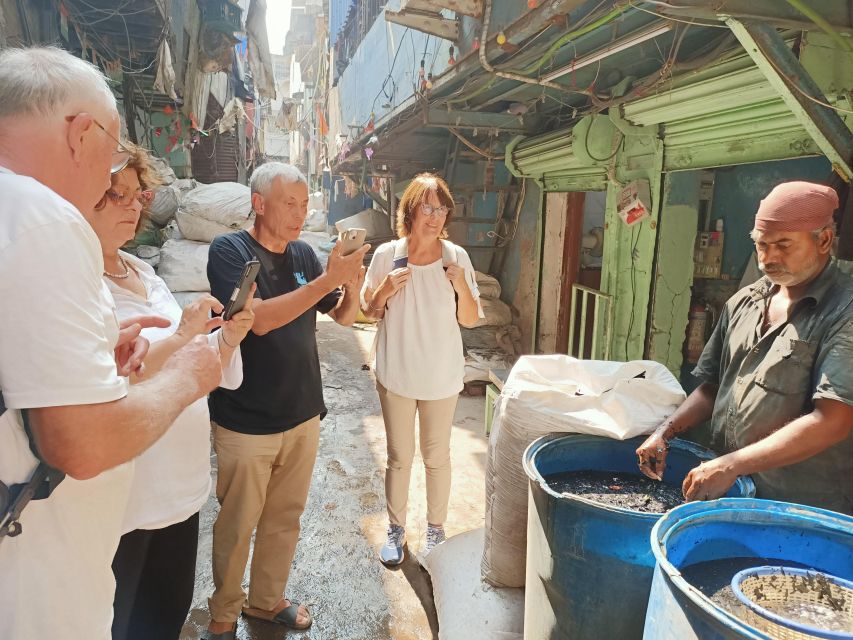
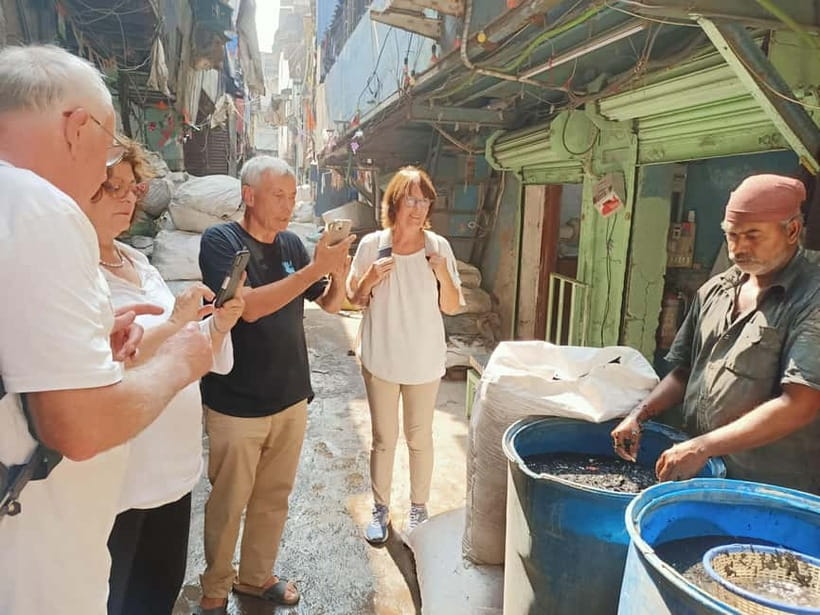
The walk is most useful when you look past the word slum. Dharavi contains homes and industries packed closely together, and the tour focuses on how people work, earn money, and support their families. You may see different kinds of small-scale production and businesses along the route, though the exact stops can vary.
One account describes workers spending long days earning money for their families. That detail gives the area a human scale. You are not simply looking at crowded buildings. You are seeing a place where people have built livelihoods under difficult conditions.
The lanes can be narrow, and you should expect a walking tour rather than a bus ride with distant views. Wear practical shoes and keep your clothing modest. Short skirts and skirts are listed as not allowed, so choose trousers or another respectful option. Bottled mineral water is included, but you may still want to arrive hydrated, especially in warm weather.
Photography deserves care here. The information supplied does not set out a formal camera policy, so ask your guide before photographing people, homes, or work areas. A polite question takes only a second, and it helps keep the tour respectful.
The guide can make or break this section. Bhaarti is described as a local resident who knows many people in the area. Abhishek is also described as living in Dharavi and answering questions from direct personal experience. Hardik and Alkama have also been praised for clear explanations and an engaging manner. Guides are assigned rather than selected by you, so the exact person may differ from these names.
Same tracks, a very different ride:
- Mumbai: Dhobi Ghat Tour with Dharavi and Train Ride Options
★ 3.4 · 5 reviews - Dharavi Slum & Dhobi Ghat Mumbai: Private Guided Tour
★ 5.0 · 4 reviews - Dhobi Ghat Laundry and Dharavi Slum Tour with Local Train
★ 5.0 · 4 reviews - Mumbai Unseen: Local Train Ride And Sightseeing Tour
★ 5.0 · 3 reviews
What the three-hour route feels like

The route is compact but full. You meet at Third Wave Coffee, visit Dharavi for a guided walk, take the local train, and finish at the Dhobi Ghat Viewing Deck. The written order of the stops is not entirely consistent with the descriptive text, which places Dhobi Ghat before the train and Dharavi. Confirm the sequence with the guide at the meeting point.
That small uncertainty should not worry you, but it is worth knowing. The overall experience is clearly built around three elements: Dhobi Ghat, the train, and Dharavi. The order may change to suit the day’s transport or meeting arrangements.
A three-hour schedule gives you enough time for an introduction to each part, but not for long conversations at every stop. If you want an extensive social or historical study of Dharavi, you will need more time elsewhere. If you want a concentrated first look at three connected parts of Mumbai life, the pace works well.
The group limit of 10 is another practical advantage. You can hear the guide in narrow lanes, ask about what you are seeing, and keep the group together near the train. A small group does not remove the intensity of Dharavi, but it makes the walking portion easier to manage.
Is $26 a fair price?
At $26 per person, the tour offers solid value. The cost includes an English-speaking guide, train tickets, bottled mineral water, and a three-hour route covering three distinct experiences. Buying a train ticket is inexpensive on its own, but the guide, route planning, and access to local explanations add most of the value.
You are paying for interpretation, not luxury. There is no mention of a private vehicle, meal, hotel pickup, or premium attraction entry. If you want comfort and air conditioning, this is not the right product. If you want a planned route that connects places you might struggle to combine independently, the price is reasonable.
The small group also helps justify the cost. A group of up to 10 is more personal than a large coach tour, particularly in Dharavi’s narrow lanes. You have a better chance of hearing the guide and asking a question about a business, building, or daily routine.
I would book this tour for the access and local perspective, not simply for photographs. Dhobi Ghat makes good images, but the strongest value comes from understanding why these places function as they do.
Who should take this tour?

You will get the most from this experience if you are curious about ordinary city life and willing to see Mumbai beyond its postcard sights. It suits first-time visitors who want a strong introduction to the city’s workers, transport, and neighborhoods.
It is also a good choice if you have wanted to ride a Mumbai local train but did not feel ready to handle the system alone. The guide gives you a practical way to try it without building your entire day around route planning.
Families with older children may find the tour educational, though parents should decide how their children will respond to crowded streets and difficult subjects. The experience is not designed as light entertainment.
You may want to skip it if you dislike walking, crowded public transport, or tours that focus on poverty and working conditions. Dharavi should not be treated as a spectacle. Go with patience, listen to the guide, and keep your camera secondary to the people and place.
Practical details before you go
Meet at Third Wave Coffee. The tour finishes at the Dhobi Ghat Viewing Deck, so plan your next activity from that area rather than assuming you will return to the starting point.
The tour is in English, and the group is limited to 10 people. Train tickets and bottled water are included. Short skirts and skirts are not allowed, so dress modestly and sensibly for walking.
You can cancel up to 24 hours before the start for a full refund, and the reserve-now, pay-later option lets you keep your plans flexible. Starting times vary, so check availability for your date.
The activity is advertised as three hours. Because the written breakdown includes incorrect-looking entries of 10 hours for the train and 30 hours for Dhobi Ghat, confirm the meeting time and route order when you book. The total duration, rather than those individual entries, is the useful figure.
Should you book the Dhobi Ghat and Dharavi tour?
I would book it if you want an honest, compact look at Mumbai’s working life, especially if the local train ride appeals to you. The combination is unusual: a laundry viewed from above, a public train ride, and a guided walk through one of the city’s best-known working communities.
The tour depends heavily on the guide, but the available guide names suggest strong local experience. Bhaarti and Abhishek bring personal ties to Dharavi, while Hardik and Alkama are praised for clear and engaging explanations. You should still approach the walk with respect and realistic expectations.
Book it for context, not comfort. At $26, with a small group, train tickets, water, and three focused stops, it is a good-value introduction to a side of Mumbai that most sightseeing routes miss.
FAQ
How long is the Mumbai Dharavi and Dhobi Ghat tour?
The tour duration is three hours.
Where does the tour start?
The meeting point is Third Wave Coffee.
Where does the tour finish?
The tour finishes at the Dhobi Ghat Viewing Deck.
Is the local train ticket included?
Yes. A train ticket is included in the tour price.
Is bottled water included?
Yes. Bottled mineral water is included.
What language is the tour conducted in?
The tour is conducted in English with a live English-speaking guide.
How large is the group?
The tour is offered as a small group with a maximum of 10 participants.
Can I cancel for a full refund?
Yes. You can cancel up to 24 hours in advance for a full refund.
Just added around Mumbai
- Mumbai Unseen: Local Train Ride And Sightseeing Tour★ 5.0 · 3 reviews
- Mumbai Slum Tour with Dhobi Ghat Laundry & Train Ride Tour★ 5.0 · 2 reviews
- All in one-Combo of City, Dhobighat, Slum & Dabbawala with ferry and train ride.★ 4.5 · 2 reviews
- Dharavi Slum & Dhobi Ghat Mumbai: Private Guided Tour★ 5.0 · 4 reviews
- Meet Dabbawala Visit Dhobi Ghat & Dharavi slum with Train★ 5.0 · 2 reviews
- Mumbai: Dhobi Ghat Tour with Dharavi and Train Ride Options★ 3.4 · 5 reviews
- Dhobi Ghat Laundry and Dharavi Slum Tour with Local Train★ 5.0 · 4 reviews
- Dabbawaala Dhobi Ghat Dahravi slum With Local Train Ride★ 5.0 · 2 reviews
Mumbai Train Tours, compared.

Dabbawala, Dhobi Ghat & Dharavi slum Tour with Local Train Ride
Read our review →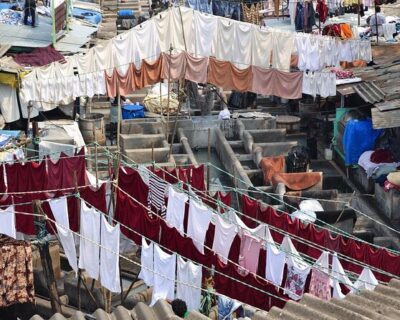
Primmum Mumbai Sightseeing With Local Train Ride Experience
Read our review →
Mumbai City + Dabbawala aka Lunchbox + Train Ride Tour – The Unfeigned Mumbai.
Read our review →
Dhobi Ghat Tour with Dharavi and Train Ride Options
Read our review →
Dhobi Ghat Laundry and Dharavi Slum Tour with Local Train
Read our review →
Dharavi Slum & Dhobi Ghat Mumbai: Private Guided Tour
Read our review →
Best Combo Tour: Dabbawalas, Dhobi Ghat and Slum with Train
Read our review →
Mumbai Unseen: Local Train Ride And Sightseeing Tour
Read our review →Browse the lists this tour appears in